
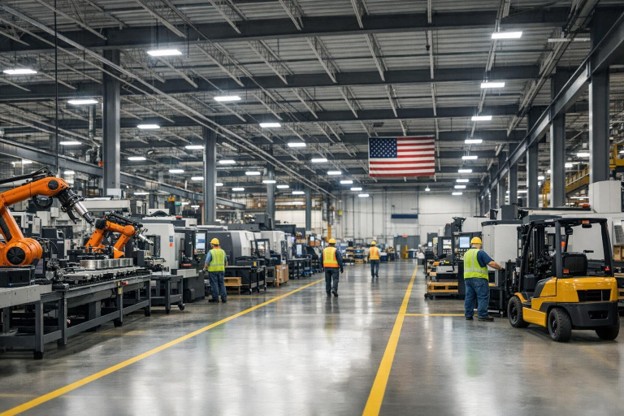
Demand Is Surging Where Precision Matters Most
The reshoring wave is not spread evenly. It is heaviest in exactly the industries that cannot tolerate sloppy cuts: aerospace, defense, energy, and advanced industrial manufacturing. Aerospace alone is running at a historic pace. The International Air Transport Association reports that the global commercial aircraft order backlog has surpassed 17,000 aircraft — a record high equal to nearly 60 percent of the active fleet, and roughly twelve years of production at current rates. That backlog cascades down through every tier of the supply chain, into the brackets, gaskets, structural components, and prototype parts that regional shops are asked to produce.
Layer on a historic rebuild of the domestic defense-industrial base, and the picture sharpens further. Manufacturers ramping to meet all of this demand share a common problem: they need parts cut cleanly, accurately, and quickly, often from difficult or heat-sensitive materials, and they need it done close to home rather than shipped across the country or overseas. That combination — rising volume, tighter tolerances, tougher materials, and a premium on speed and proximity — is precisely what has pushed waterjet cutting from a niche capability into a mainstream production tool.
Why Waterjet Fits the Moment
Waterjet’s core advantage is that it cuts cold. Abrasive waterjet combines ultra-high-pressure water with garnet abrasive to slice through material without generating a heat-affected zone, the band of thermal damage that laser and plasma leave along a cut edge. For a full breakdown of that distinction, see our existing guide to the heat-affected zone. The practical result is a distortion-free edge that comes off the table in specification, with no warping, edge hardening, or structural change — and, on most parts, no secondary finishing.
That cold-cutting behavior lines up almost perfectly with what the current manufacturing surge demands. Reshored aerospace and defense work leans heavily on materials — titanium, nickel alloys, carbon fiber composites, hardened plate — that thermal cutting struggles with. Waterjet handles them without compromise. Just as important, one waterjet system cuts across an enormous range of materials and thicknesses, from thin-gauge sheet to thick plate, so a single flexible process can serve a job shop’s whole mix rather than requiring a different machine for every material. For manufacturers scaling into unfamiliar territory, that versatility lowers risk and shortens the path from design to finished part.
The Materials Behind the Boom
Look closer at what reshored and expanding manufacturers are actually cutting, and three material stories stand out — each a demand driver in its own right, and each a place where waterjet has a decisive edge.
Titanium is the first. Aerospace and defense titanium demand is surging even as supply stays tight, making the metal both scarce and expensive to cut without waste — a dynamic we examine in Why the Aerospace Titanium Crunch Makes Waterjet the Smart Way to Cut It. Composites are the second: carbon fiber is spreading across aircraft, defense platforms, and electric vehicles, and cutting it without delamination is a genuine challenge, as detailed in Cutting Carbon Fiber Without Delamination: Waterjet’s Edge as Composites Demand Soars. And defense is the third, where a generational buildup of the industrial base is generating enormous demand for precision-cut components across metals and composites alike — the focus of The Defense Manufacturing Surge Runs on Precision Cutting — and Waterjet Delivers. In each case, the same cold, material-agnostic precision that defines waterjet is what makes it the right tool for the job.
Material Efficiency Becomes a Competitive Edge
Reshoring does not happen in a vacuum. It is unfolding alongside rising input costs and trade pressure that have pushed the price of steel, aluminum, and specialty metals higher — which means every square inch of expensive stock a shop wastes cuts directly into margin. That reality has quietly turned material efficiency into a competitive advantage rather than an afterthought.
Waterjet helps on both sides of that equation. Its narrow cutting stream removes very little material at the kerf, and intelligent nesting software packs parts tightly onto each sheet to squeeze the maximum number of finished pieces out of every plate. On costly aerospace and defense alloys, that yield difference adds up quickly across a production run. It is also one of the reasons waterjet often compares favorably on total cost even when raw cutting speed is not its headline strength — a topic we break down in our guide to waterjet cutting cost. When the material itself is scarce and expensive, cutting it with minimal waste is not a rounding error. It is strategy.
Why Domestic and Local Matters Now
Reshoring is fundamentally about shortening supply chains and reducing risk, and that logic does not stop at the loading dock. A manufacturer that reshores production only to send parts out of state for cutting has reintroduced exactly the lead-time and logistics exposure it was trying to eliminate. A local waterjet partner closes that gap. Parts get cut nearby, turnarounds stay short, shipping costs and transit risk shrink, and communication happens directly rather than through layers of coordination. For prototype iterations and short production runs — the lifeblood of a scaling operation — that responsiveness is often the difference between hitting a schedule and slipping it.
The Southeast’s position at the heart of the reshoring surge makes this especially relevant. As new aerospace, automotive, and industrial capacity clusters across the Carolinas and the broader region, the manufacturers building it need cutting partners who are in the same time zone, on the same schedule, and reachable on the same day.
FP Waterjet: Domestic Precision Cutting for the Upstate
FP Waterjet delivers exactly that. Based in Landrum, South Carolina, we provide abrasive waterjet cutting for manufacturers across the Greenville-Spartanburg-Asheville corridor and the broader Upstate — clean edges, tight tolerances, and zero heat distortion on metal, foam, plastic, and composite stock. Our cold-cutting process handles both one-off prototypes and full production runs with the same accuracy, and intelligent nesting maximizes material yield on every job. From quote through delivery, our team stays directly accessible, with no out-of-state shipping and no corporate layers between you and your parts.
Our Services Include:
- Waterjet Cutting Services — Abrasive waterjet cutting on metal, foam, plastic, and composites, with clean edges and no heat-affected zone across a wide range of thicknesses.
- Industries Served — Precision cutting for aerospace, automotive, gas turbine, oil and gas, and general manufacturing across Upstate South Carolina.
Ready to Transform Your Operations? Contact FP Waterjet to discuss your requirements or send your CAD files and get an accurate quote before any material is cut.
Works Cited
“Aerospace Supply Chain Bottlenecks Continue to Constrain Airlines.” International Air Transport Association, 9 Dec. 2025, www.iata.org/en/pressroom/2025-releases/2025-12-09-02/. Accessed 13 July 2026.
“Reshoring Initiative 2024 Annual Report Including 1Q2025 Insights.” Reshoring Initiative, 9 June 2025, reshorenow.org/june-9-2025/. Accessed 13 July 2026.
Related Articles
- Why the Aerospace Titanium Crunch Makes Waterjet the Smart Way to Cut It
- Cutting Carbon Fiber Without Delamination: Waterjet’s Edge as Composites Demand Soars
- The Defense Manufacturing Surge Runs on Precision Cutting — and Waterjet Delivers
About the Author
Chris Urban is the Founder of Forged Path Automation. His 26+ year manufacturing career spans from an international manufacturing specialist trained in Zurich, Switzerland, to corporate President and business owner. Before launching Forged Path Automation (FPA), Chris scaled an industrial gas turbine business unit from its infancy to $50M in value, directed the zero-downtime relocation of 100+ industrial machines to a 150,000 sq. ft. Center of Excellence, and led US operations for a $2.3B global firm. Today, Chris leverages his deep technical roots and an MBA to engineer turnkey robotic finishing cells that deliver total production stability and clear ROI for high-mix manufacturers. Chris holds an advanced background in both the technical and financial sides of manufacturing, combining studies in Applied Science with a Master of Business Administration.
Connect with Chris on LinkedIn to talk shop or discuss your floor’s ROI.
Follow FP Waterjet on LinkedIn or visit FPWaterjet.com.