
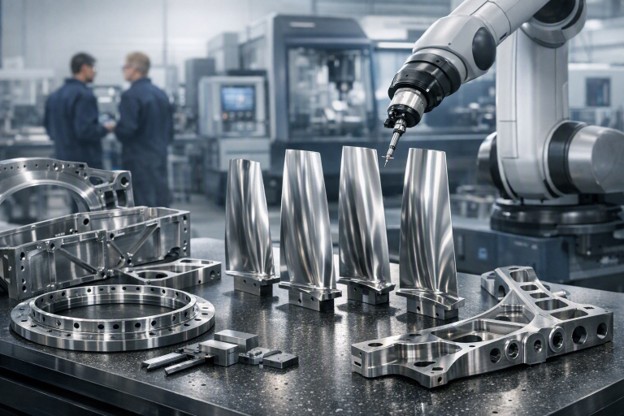
The answer increasingly points to abrasive waterjet. To understand why, it helps to look at just how strained the titanium picture has become.
A Metal the U.S. No Longer Makes
The supply side of titanium has quietly reached a breaking point. According to the U.S. Geological Survey’s Mineral Commodity Summaries, the United States did not produce any titanium sponge metal in 2025 — the last domestic sponge plant closed in 2024. As a result, USGS lists U.S. net import reliance for titanium sponge at 100 percent, meaning the entire domestic supply of the raw material now arrives from abroad, led by Japan, Kazakhstan, and Saudi Arabia.
Those imports are also at record levels. USGS estimates the U.S. brought in roughly 44,000 tons of titanium sponge in 2025, surpassing the previous high set in 2023. And the agency is explicit about where the metal goes: the majority of titanium metal is consumed by aerospace applications, with the remainder split among armor, chemical processing, marine hardware, medical implants, and power generation. In other words, the country is now entirely dependent on foreign sources for a strategically critical metal that feeds its aircraft and defense programs.
Demand Is Climbing, Not Falling
If supply has tightened, demand is pulling in the opposite direction. Titanium consumption tracks aerospace build rates, and those rates are rising. Airbus, whose A350 is its most titanium-intensive aircraft at roughly 15 percent of airframe weight, is actively pulling procurement forward to get ahead of the ramp. As reported by The Metalnomist, Airbus now expects its 2027 titanium demand to run about 30 percent higher than it had forecast a year earlier, and is moving purchases into 2026 specifically to avoid a supply-chain shock.
The production numbers behind that forecast are steep. Airbus is building the A350 at about seven per month, up from five to six at the end of 2025, and plans to reach ten per month in 2027 and twelve in 2028 — with the mix tilting toward the larger, more material-hungry A350-1000. Because aerospace titanium cannot be swapped for unqualified material or sourced on short notice — qualified melt, plate, bar, sheet, and forgings carry long lead times and strict certification — even a modest jump in build rates ripples hard through the supply chain. The macro picture driving all of this is the record aircraft backlog we cover in Reshoring and the Aerospace Boom Are Fueling Demand for Domestic Waterjet Cutting.
Why Titanium Is So Hard to Cut
Put those two forces together — vanishing domestic supply and rising demand — and titanium becomes a metal you cannot afford to waste or damage. Unfortunately, it is also one of the harder metals to cut well. Titanium is tough, it work-hardens, and it is notably sensitive to heat. Those properties are exactly why it performs so well in an engine or an airframe, and exactly why cutting it is unforgiving.
Thermal cutting methods are where the trouble starts. Laser and plasma both cut by melting material, and that heat leaves a heat-affected zone along the edge — a band where the metal’s microstructure and properties have been altered by thermal stress. On a fatigue-critical aerospace or defense component, that altered edge is a genuine liability, and removing it means additional machining, additional handling, and additional risk of scrapping an expensive part. We break down that phenomenon in detail in our guide to the heat-affected zone. When the material in question is a 100-percent-imported, record-priced metal destined for flight hardware, introducing thermal damage at the cut edge is precisely the wrong way to start.
Waterjet’s Edge on Titanium
This is where abrasive waterjet’s cold-cutting process becomes decisive. Because waterjet cuts by eroding material with a high-pressure stream of water and garnet abrasive rather than melting it, it generates no heat-affected zone at all. The titanium comes off the table with its original microstructure and material properties fully intact — no thermal alteration, no edge hardening, no distortion. For parts that will see high cyclic loads in an aircraft or a turbine, that undisturbed edge is not a nicety; it is a requirement.
Just as important in a supply crunch is what waterjet does for yield. Its cutting stream is narrow, removing very little material at the kerf, and intelligent nesting packs parts tightly across each plate to extract the maximum number of finished pieces from every sheet of costly titanium. When the raw material is scarce and expensive, that efficiency translates directly into lower cost per part and less waste of a metal the country can no longer make for itself. Waterjet also handles the full range of thicknesses aerospace work demands, from thin sheet to heavy plate, on a single system — a versatility that matters across every difficult material, as we explore in The Defense Manufacturing Surge Runs on Precision Cutting — and Waterjet Delivers. And because most parts come off the table in specification, there is rarely a need for the secondary finishing that thermal cuts require.
The logic is straightforward. When a metal is this precious and this demanding, the cutting process should preserve its properties and conserve its volume — and cold abrasive waterjet does both.
When a Scrapped Part Costs More Than Ever
It is worth pausing on what a ruined titanium part actually costs in this environment. When the metal was cheaper and domestic supply existed, a scrapped blank was a manageable loss. Today, with the U.S. producing none of its own sponge and prices near record highs, every rejected part represents wasted imported material, wasted machine time, and a replacement that may sit behind a long queue of certified stock. The risk is no longer just financial — it is schedule risk on programs that are already supply-constrained.
That shift changes the calculus on cutting method. A process that introduces thermal damage and forces rework is not just slower; it actively raises the odds of scrapping an irreplaceable blank. A cold process that preserves the metal and maximizes the number of good parts per plate is, in effect, a form of supply-chain insurance. On a metal this scarce, protecting yield and integrity at the cutting stage is one of the few levers a shop fully controls.
FP Waterjet: Precision Titanium Cutting in Upstate South Carolina
FP Waterjet cuts aerospace-grade titanium and other demanding alloys the way high-value work requires: cold, clean, and to specification. From our facility in Landrum, South Carolina, we serve aerospace, defense-adjacent, and industrial manufacturers across the Greenville-Spartanburg-Asheville corridor with distortion-free cuts, tight tolerances, and material-efficient nesting that respects the cost of every plate. Whether you need a single prototype or a full production run, our team stays directly accessible from quote through delivery.
Our Services Include:
- Aerospace Waterjet Cutting — Cold, distortion-free cutting of titanium, aerospace alloys, and composites, with the edge quality and tolerances flight-critical parts demand.
- Waterjet Cutting Services — Abrasive waterjet cutting on metal, foam, plastic, and composites, with no heat-affected zone across a wide range of thicknesses.
Ready to Transform Your Operations? Contact FP Waterjet to discuss your titanium requirements or send your CAD files for an accurate quote before any material is cut.
Works Cited
“Airbus Titanium Procurement Pull-Forward Aims to Prevent 2027 Supply Chain Shock.” The Metalnomist, 23 June 2026, www.metalnomist.com/2026/06/airbus-titanium-procurement-pull.html. Accessed 13 July 2026.
“Titanium and Titanium Dioxide.” Mineral Commodity Summaries 2026, U.S. Geological Survey, Feb. 2026, pubs.usgs.gov/periodicals/mcs2026/mcs2026-titanium.pdf. Accessed 13 July 2026.
Related Articles
- Reshoring and the Aerospace Boom Are Fueling Demand for Domestic Waterjet Cutting
- Cutting Carbon Fiber Without Delamination: Waterjet’s Edge as Composites Demand Soars
- The Defense Manufacturing Surge Runs on Precision Cutting — and Waterjet Delivers
About the Author
Chris Urban is the Founder of Forged Path Automation. His 26+ year manufacturing career spans from an international manufacturing specialist trained in Zurich, Switzerland, to corporate President and business owner. Before launching Forged Path Automation (FPA), Chris scaled an industrial gas turbine business unit from its infancy to $50M in value, directed the zero-downtime relocation of 100+ industrial machines to a 150,000 sq. ft. Center of Excellence, and led US operations for a $2.3B global firm. Today, Chris leverages his deep technical roots and an MBA to engineer turnkey robotic finishing cells that deliver total production stability and clear ROI for high-mix manufacturers. Chris holds an advanced background in both the technical and financial sides of manufacturing, combining studies in Applied Science with a Master of Business Administration.
Connect with Chris on LinkedIn to talk shop or discuss your floor’s ROI.
Follow FP Waterjet on LinkedIn or visit FPWaterjet.com.