
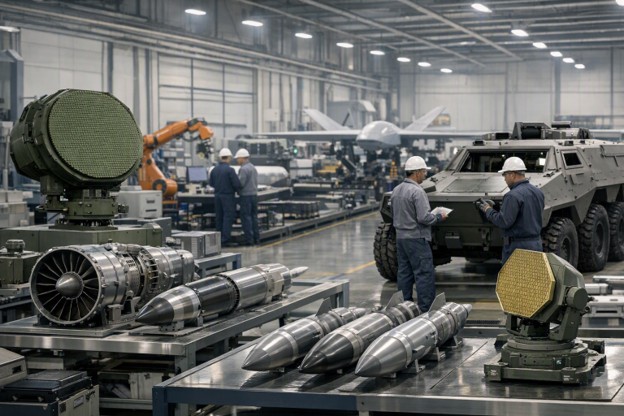
A Defense Buildup Not Seen in Decades
The scale of the current push is striking. According to the White House’s 2026 Economic Report of the President, spending for procurement, research and development, and defense-industrial-base expansion is up more than a third under recent legislation — a deliberate move to reverse decades of decline in defense manufacturing capacity. The same report notes that defense-related employment fell by roughly 2.1 million between 1985 and 2021, a hollowing-out the current buildup is meant to reverse.
That reversal is already visible in the numbers. Analysis from the Center for Strategic and International Studies finds that roughly 10,000 new firms have entered the defense market over the past two years, and that total munitions contract obligations have risen 330 percent since 2010. New entrants and nontraditional vendors — many of them agile startups rather than legacy primes — are flooding into the sector, adding both capacity and competition. Every one of those firms needs parts, and many of them lack the in-house equipment to cut those parts themselves.
From Missiles to Drones: Mass Production Is the Mandate
The defining feature of this buildup is volume. The Pentagon is no longer only buying small numbers of exquisite weapons; it is pushing for mass. CSIS reports that the Department of Defense launched a Drone Dominance Program in December 2025 — a $1.1 billion initiative to scale domestic drone production and field roughly 300,000 units by the end of 2027. On the missile side, the Pentagon is working to lift PAC-3 interceptor capacity from about 600 to 2,000 units per year by 2030, part of a broader effort to attack munitions manufacturing lead times that currently run anywhere from 25 to 51 months.
Hitting those targets means producing enormous quantities of physical hardware, and drones in particular translate almost directly into cutting work: airframes, mounting plates, structural ribs, and enclosures, produced in high volume and frequent design revisions. This is exactly the high-mix, fast-turnaround environment that rewards flexible cutting — and it is the same demand wave, viewed from the defense side, that we describe in Reshoring and the Aerospace Boom Are Fueling Demand for Domestic Waterjet Cutting.
Why Precision Cutting Sits at the Heart of It
Defense hardware spans nearly every material a cutting shop encounters, and the tough ones dominate. Titanium shows up in armor and airframes — a metal so strategically central that the U.S. now imports all of its titanium sponge, as we cover in Why the Aerospace Titanium Crunch Makes Waterjet the Smart Way to Cut It. Carbon fiber composites form the bones of modern drones and aircraft, with their own cutting challenges, detailed in Cutting Carbon Fiber Without Delamination: Waterjet’s Edge as Composites Demand Soars. Add hardened steels, aluminum, and specialty alloys, and a single defense supplier may need to cut all of them — sometimes on the same job.
That combination punishes single-purpose cutting methods. Thermal processes leave a heat-affected zone that can compromise the structural integrity of armor and load-bearing parts, and mechanical tooling struggles with composites and wears fast on abrasive materials. For components where strength and dimensional accuracy are non-negotiable, introducing thermal damage or edge defects is not an acceptable trade-off — a distinction our guide to the heat-affected zone explains in depth.
The New Entrants Need Cutting Partners, Not Machines
One of the most consequential shifts in the defense buildup is who is doing the building. CSIS reports that obligations to nontraditional defense vendors more than doubled from $60.9 billion in 2015 to $122.6 billion in 2025, as the Pentagon deliberately courts commercial and startup suppliers to add speed and innovation. These are companies built to move quickly, and many of them are asset-light by design — they invest in engineering, software, and system integration rather than in floors full of fabrication equipment.
That model depends on capable outside partners. A drone startup racing from prototype to production does not want to buy, staff, and maintain a waterjet system to cut a few hundred airframe plates; it wants a cutting partner who can turn CAD files into finished parts on a short cycle and scale with demand. The same is true for the established suppliers absorbing surge orders beyond their in-house capacity. In both cases, a responsive, flexible job shop becomes part of the defense supply chain — and the breadth of materials and speed the mission requires make waterjet a natural fit for that role.
Waterjet’s Fit for the Defense Surge
Cold abrasive waterjet answers nearly every one of those requirements. Because it cuts without heat, it leaves no heat-affected zone, preserving the full strength and integrity of armor plate, structural members, and fatigue-critical parts. Because it is material-agnostic, one system cuts titanium, steel, aluminum, and carbon fiber alike — a decisive advantage for suppliers handling a mixed bill of materials without wanting a different machine for every one.
Just as important is agility. Waterjet works directly from CAD files, so a design revision becomes a new cut rather than new tooling, making it ideal for the rapid prototype-to-production cycles that define the new class of defense entrants. Its narrow kerf and intelligent nesting stretch expensive, sometimes import-dependent materials further, and its fast turnarounds suit both one-off prototypes and production runs. For a defense supply chain being asked to move faster, build more, and work harder materials all at once, a cutting process that is cold, flexible, and quick is precisely the right tool. In a buildup measured in hundreds of thousands of units and lead times counted in years, shaving time and waste out of the cutting step is not a minor efficiency — it is part of how the industrial base actually gets to scale.
FP Waterjet: Precision Cutting for Defense-Related Manufacturing
FP Waterjet supports defense-related manufacturers the way the mission demands: cold, accurate cutting on the toughest materials, from prototype through production. Based in Landrum, South Carolina, we serve aerospace, defense-adjacent, and general manufacturers across the Greenville-Spartanburg-Asheville corridor with distortion-free cuts, tight tolerances, and material-efficient nesting. Whether you are a legacy supplier or a new entrant scaling fast, our team stays directly accessible from quote through delivery.
Our Services Include:
- Aerospace Waterjet Cutting — Cold, distortion-free cutting of titanium, aerospace alloys, and carbon fiber composites for flight- and mission-critical parts.
- General Manufacturing Waterjet Cutting — Precision cutting of metal, plate, and composite components across a wide range of industrial and defense-related applications.
Ready to Transform Your Operations? Contact FP Waterjet to discuss your requirements or send your CAD files for an accurate quote before any material is cut.
Works Cited
McGinn, Jerry, and A.J. Dilts. “Is the Industrial Base on a Wartime Footing? A Progress Report.” Center for Strategic and International Studies, 6 July 2026, www.csis.org/analysis/industrial-base-wartime-footing-progress-report. Accessed 13 July 2026.
“Strengthening the United States’ Defense Industrial Base.” Economic Report of the President, The White House, Apr. 2026, www.whitehouse.gov/wp-content/uploads/2026/04/ERP-2026-8.-Strengthening-the-United-States-Defense-Industrial-Base.pdf. Accessed 13 July 2026.
Related Articles
- Reshoring and the Aerospace Boom Are Fueling Demand for Domestic Waterjet Cutting
- Why the Aerospace Titanium Crunch Makes Waterjet the Smart Way to Cut It
- Cutting Carbon Fiber Without Delamination: Waterjet’s Edge as Composites Demand Soars
About the Author
Chris Urban is the Founder of Forged Path Automation. His 26+ year manufacturing career spans from an international manufacturing specialist trained in Zurich, Switzerland, to corporate President and business owner. Before launching Forged Path Automation (FPA), Chris scaled an industrial gas turbine business unit from its infancy to $50M in value, directed the zero-downtime relocation of 100+ industrial machines to a 150,000 sq. ft. Center of Excellence, and led US operations for a $2.3B global firm. Today, Chris leverages his deep technical roots and an MBA to engineer turnkey robotic finishing cells that deliver total production stability and clear ROI for high-mix manufacturers. Chris holds an advanced background in both the technical and financial sides of manufacturing, combining studies in Applied Science with a Master of Business Administration.
Connect with Chris on LinkedIn to talk shop or discuss your floor’s ROI.
Follow FP Waterjet on LinkedIn or visit FPWaterjet.com.