
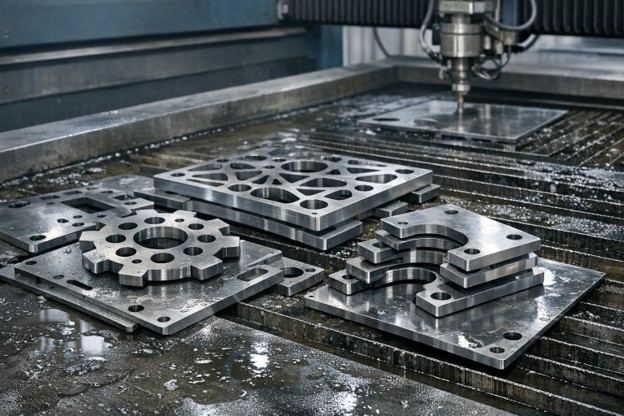
A part can pass a visual inspection and still be compromised. The cut looks clean, the dimensions check out, and the part ships — then it cracks, corrodes, or fails in assembly down the line. Often the culprit is something you cannot see at a glance: a band of damaged material along the cut edge, created by the heat of cutting itself.
A heat-affected zone is the band of material next to a cut or weld where the metal’s structure and properties have been changed by heat — even though that material was never melted away. It is the hidden cost of any thermal cutting process. This guide explains how the heat-affected zone forms, what it does to your parts, why it costs more than it looks like, and how a cold-cutting process avoids it. It is also the reason manufacturers turn to waterjet cutting services in the first place.
What a Heat-Affected Zone Actually Is
When a cutting process uses heat, only a thin line of material is actually removed. But the heat does not stop at the cut line. It spreads into the surrounding metal, and wherever it goes hot enough to change the material’s microstructure without melting it, you get a heat-affected zone.
That zone is still part of your finished part. It looks like the rest of the metal, but its hardness, strength, and behavior have shifted. The wider and more severe the zone, the more the part’s edge behaves differently from the material you specified.
How a Heat-Affected Zone Forms
Thermal cutting works by pouring energy into a small spot until the material melts or vaporizes. A laser does it with a focused beam; plasma does it with a superheated, electrically conductive gas. Either way, the temperature at the cut far exceeds the material’s melting point.
Metal conducts heat, so that energy radiates outward from the cut line. The metal just beyond the cut never melts, but it gets hot enough to transform. As it heats and then cools at different rates than the bulk of the part, its internal structure changes — and that transformed band is the heat-affected zone.
What Heat Does to the Metal in the Zone
The changes inside a heat-affected zone are real metallurgical shifts, not surface marks. Depending on the alloy, the heat can harden the edge, making it brittle and prone to cracking. In other materials it softens the edge, reducing strength where the part may need it most.
Rapid, uneven heating and cooling also lock residual stress into the part, which is what causes warping and distortion. On stainless and other corrosion-resistant alloys, heat can degrade the very property that made the material worth specifying, leaving the edge more vulnerable to rust and attack.
The Visible and Hidden Damage a HAZ Causes
Some heat-affected zone damage is obvious. Thin parts warp out of flat. Edges discolor. A recast layer or burr forms and has to be cleaned off. These you can catch on the table.
The dangerous damage is the kind you cannot see. A hardened, micro-cracked edge can pass inspection and then fail under load. A degraded corrosion-resistant surface looks fine until it starts rusting in service. Reduced fatigue life shows up only after the part has been cycling in the field. That hidden damage is why the heat-affected zone matters far more than its size suggests.
Why the Heat-Affected Zone Costs You Money
The zone shows up on your books in several places. The most immediate is secondary finishing — grinding, machining, or sanding to remove the affected edge before the part can be used. That is labor and time on every affected part.
Then there is scrap from parts that warped or cracked, and the larger cost of failures that reach a customer. Heat-based methods make this worse as geometries grow more complex, because more heat accumulates in tight features. Every one of these costs disappears when the heat does.
Which Materials Are Most Vulnerable
Heat sensitivity varies widely by material, and the most demanding jobs often use the most vulnerable ones. Hardenable steels form brittle edges. Aluminum conducts heat aggressively and distorts easily. Titanium and many aerospace alloys react badly to thermal stress.
Composites and carbon fiber are in a category of their own — heat can delaminate or burn them outright. These heat-sensitive materials are exactly the ones where a heat-affected zone does the most harm, and exactly where a cold process pays off most across our industries served.
Why Thermal Methods Create a Zone and Waterjet Does Not
Laser and plasma are both heat processes, so a heat-affected zone is not a defect in them — it is inherent to how they cut. You can minimize it with the right settings, but you cannot make it disappear, because the cutting mechanism itself is heat.
Waterjet cuts a different way. It removes material by erosion, using a high-pressure stream of water and garnet abrasive. There is no heat input at all, so there is no zone to manage. The full trade-offs between the methods are covered in our guide to waterjet vs. laser cutting.
Heat-Affected Zone by Cutting Method
The differences line up clearly side by side.
| Method | Heat-Affected Zone | Common Effects | Secondary Finishing |
| Waterjet | None — cold process | Edge keeps original properties | Rarely needed |
| Laser | Small to moderate | Discoloration, recast layer, hardened edge | Sometimes |
| Plasma | Largest of the three | Warping, hardened and oxidized edge | Often |
How Waterjet Eliminates the Heat-Affected Zone
Because a waterjet adds no heat, the metal beside the cut never changes. The edge comes off the table with the same hardness, strength, and corrosion resistance as the rest of the part. What you specified is what you get, all the way to the cut line.
That changes the math on a job. With no zone to grind away, most parts need no secondary finishing. With no thermal stress, parts do not warp. And with no metallurgical change at the edge, there is no hidden weakness waiting to fail later. The cut is simply done when it comes off the table.
Where a Zero-Heat Cut Matters Most
Some parts can live with a small heat-affected zone. Many cannot. Tight-tolerance components cannot afford the warping that thermal stress introduces. Parts headed for coating or bonding need an unaltered edge for the finish to adhere. Safety-critical and high-value parts cannot carry hidden edge weakness.
Aerospace and gas turbine work checks every one of those boxes, which is why heat-sensitive alloys and tight tolerances make waterjet the default there. When the cost of a failed part is high, eliminating the heat-affected zone is not a nicety — it is the requirement.
How to Tell if a Heat-Affected Zone Is Hurting Your Parts
A few signs point to thermal damage as the real problem:
- Parts warp or lose flatness after cutting, especially thin or large pieces.
- Cut edges discolor, harden, or show a recast layer that needs cleaning.
- You routinely grind or machine edges before parts can move downstream.
- Corrosion-resistant materials start rusting at the cut edge in service.
- Parts crack or fail along cut edges under load or fatigue.
If these sound familiar, the cutting heat — not the design or the material — is likely the cause.
Cut Without the Heat
The heat-affected zone is the quiet tax on every thermal cut: secondary finishing, scrap, warping, and the failures you do not see coming. A cold cut removes that tax entirely, leaving an edge that keeps every property you paid for. If heat damage is showing up in your parts, it is worth cutting a different way. FP Waterjet is founder-led and based at our Landrum, South Carolina shop, serving the Greenville-Spartanburg and Asheville corridor. Send us your CAD files and we will cut your parts cold — no zone, no surprises.
FP Waterjet is a founder-led abrasive waterjet cutting shop in Landrum, South Carolina, serving Upstate manufacturers with clean, distortion-free cuts and fast, local turnaround.
About the Author
Chris Urban is the Founder of Forged Path Automation. His 26+ year manufacturing career spans from an international manufacturing specialist trained in Zurich, Switzerland, to corporate President and business owner. Before launching Forged Path Automation (FPA), Chris scaled an industrial gas turbine business unit from its infancy to $50M in value, directed the zero-downtime relocation of 100+ industrial machines to a 150,000 sq. ft. Center of Excellence, and led US operations for a $2.3B global firm.
Today, Chris leverages his deep technical roots and an MBA to deliver precision waterjet cutting services, dependable production capacity, and rapid turnaround times for local and national manufacturers spanning from single prototypes to full production runs. He holds an advanced background in both the technical and financial sides of manufacturing, combining studies in Applied Science with a Master of Business Administration.
Connect with Chris on LinkedIn to talk shop or discuss your production needs.
Follow Forged Path Waterjet on LinkedIn or visit FPWaterjet.com.