
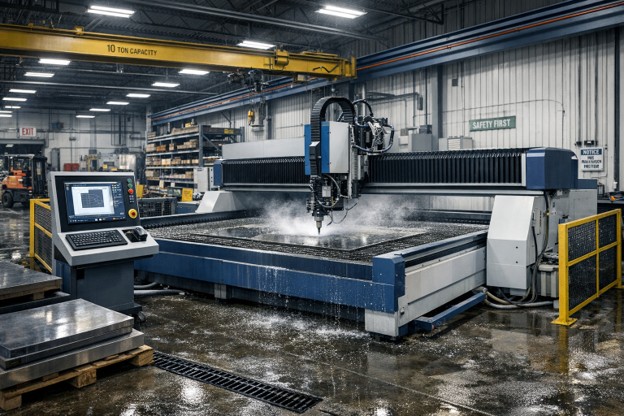
If you are sourcing cut parts, the choice usually comes down to two options: waterjet or laser. Both produce clean, accurate parts. Both run off your CAD files. And both are a real step up from a saw or a hand torch. So the question is not which one is better in general — it is which one is better for your parts, your materials, and your tolerances.
Waterjet vs laser cutting comes down to one thing: heat. A waterjet cuts cold with a high-pressure abrasive stream, while a laser cuts with a focused, heat-generating beam — and that single difference drives everything else. Cut quality, the materials you can run, the thicknesses each handles, and the cost all flow from it. This guide walks through each factor so you can match the process to the job, and the FP Waterjet waterjet cutting services that follow from it.
How Waterjet and Laser Cutting Actually Work
A waterjet cuts by force, not heat. It drives water through a tiny orifice at extreme pressure, mixes in garnet abrasive, and erodes a clean path through the material. Nothing gets hot. The process is essentially a controlled, ultra-fast form of erosion.
A laser cuts by heat. It focuses an intense beam on a small spot, melting or vaporizing the material, while a gas jet blows the molten material away. It is fast and precise on the right material — but by definition, it puts heat into the part. That distinction is the root of every other difference below.
The Core Difference: Cold Cutting vs. Heat
Because a laser cuts with heat, it leaves a heat-affected zone — a band along the cut edge where the material’s properties have changed. That zone can warp thin parts, harden edges, and stress heat-sensitive materials. A waterjet leaves none of it, so the edge keeps the same properties as the rest of the part.
For many jobs this is the whole decision. If your material or tolerances cannot tolerate thermal distortion, the cold process wins before any other factor is weighed. We cover this in depth in our guide to the heat-affected zone, but the short version is simple: heat changes parts, and waterjet does not add heat.
Cut Quality and Edge Finish Compared
Waterjet edges come off the table clean and ready to use. There is no slag, no burn marks, and on most jobs no secondary finishing. That saves a downstream step many shops forget to price in.
Laser edges are clean too, especially on thin sheet, but heat input can leave discoloration, a small recast layer, or a slightly hardened edge depending on the material. On parts headed for coating, bonding, or tight assembly, those heat effects sometimes have to be removed. Waterjet sidesteps that work entirely.
Precision and Tolerances Compared
Both processes are precise, and for a lot of work either will hold what you need. On the very finest detail and the smallest holes in thin material, a laser has an edge. For overall accuracy without heat distortion, waterjet is hard to beat, holding roughly a few thousandths of an inch across a wide range of materials and thicknesses.
The key point is consistency. Because a waterjet adds no heat, the part that comes off the table is the part the program called for — it has not moved, warped, or grown from thermal stress. That stability matters most on larger parts and on materials that react to heat.
Materials Each Process Can Handle
This is where the gap widens. A laser is built primarily for metals, with limited reach into some plastics. A waterjet cuts almost anything: metal, foam, plastic, rubber, composites, and stone among them.
The materials a laser struggles with are exactly the ones waterjet handles best — heat-sensitive metals, composites, and carbon fiber that thermal cutting can warp or delaminate. If your shop runs a mix of materials, one waterjet covers ground that would take a laser plus other equipment.
Thickness: Where Each Process Wins
Laser cutting shines on thin-gauge sheet, where it is fast and crisp. As material gets thicker, a laser slows down, struggles, and eventually cannot make the cut at all — most lasers top out around an inch.
Waterjet does not hit that wall. It cuts thin material cleanly and keeps going well into thick plate, holding edge quality the whole way. For thick or variable-thickness work, waterjet is usually the only one of the two still in the running.
Speed and Cost Considerations
On thin metal in volume, a laser is typically faster, and speed is part of cost. Waterjet cuts more slowly, especially as thickness climbs. Looked at purely as a per-hour rate, that can make waterjet seem like the pricier option.
The fuller picture is different. When you factor in the secondary finishing heat often requires, the scrap from warped parts, and the jobs a laser simply cannot run, waterjet frequently comes out even or ahead on total cost. The right comparison is cost per finished, in-spec part — not cost per hour.
Waterjet vs. Laser Cutting: Side-by-Side
Here is the comparison at a glance, with plasma included since it is the third option many shops weigh.
| Factor | Waterjet | Laser | Plasma |
| Heat-affected zone | None — cold process | Yes | Yes, the largest |
| Materials | Metal, foam, plastic, composites, stone | Mostly metals, some plastics | Conductive metals only |
| Thickness | Thin sheet to thick plate | Best on thin sheet | Thick conductive plate |
| Precision | Highest, no heat distortion | High on thin material | Lowest |
| Edge finish | Clean, usually no finishing | Clean, possible heat marks | Rougher, needs cleanup |
| Speed | Slower | Fastest on thin sheet | Fast on thick metal |
| Best for | Heat-sensitive, thick, mixed materials | Fast, fine detail in thin metal | Thick conductive metal at low cost |
Where Plasma Fits In
Plasma is the budget option for thick conductive metal, and it is fast. But it cuts only metals that conduct electricity, it leaves the largest heat-affected zone of the three, and its edges are the roughest — usually needing cleanup before the part is usable.
For rough, fast cuts on thick steel where edge quality is not critical, plasma earns its place. For anything requiring tight tolerances, clean edges, or non-metal materials, it drops out of the conversation quickly.
When Waterjet Is the Right Call
Waterjet is the clear choice when heat is the enemy or the material mix is wide. It fits when your parts are heat-sensitive metals, composites, or carbon fiber, when material runs thick or varies in thickness, and when you need clean edges with no secondary finishing.
It also fits when one process needs to cover many materials — metal one day, foam or plastic the next. Aerospace and gas turbine parts, where alloys are often heat-sensitive and tolerances are tight, are a textbook waterjet application, which is why they feature heavily across our industries served.
When Laser Makes More Sense
It is worth being honest about the other side. If your work is high-volume, thin-gauge sheet metal with fine detail and no heat sensitivity, a laser is often the faster, more economical pick. Tiny holes and intricate features in thin material play directly to a laser’s strengths.
The decision is rarely about which machine is “better.” It is about matching the process to the part. The wrong call costs you in rework, scrap, or jobs you cannot run; the right one pays off on every part.
Choosing the Right Cutting Partner
Once you have the process right, the partner matters just as much. FP Waterjet is founder-led and based in Landrum, South Carolina, cutting clean, distortion-free parts for the Greenville-Spartanburg and Asheville corridor — with direct team access from quote to delivery and no out-of-state shipping. If you are weighing waterjet vs laser cutting for a specific part, send us the details. Contact our team with your CAD files and we will tell you straight whether waterjet is the right fit — and you can learn more about our shop anytime.
FP Waterjet is a founder-led abrasive waterjet cutting shop in Landrum, South Carolina, serving Upstate manufacturers with clean, distortion-free cuts and fast, local turnaround.
About the Author
Chris Urban is the Founder of Forged Path Automation. His 26+ year manufacturing career spans from an international manufacturing specialist trained in Zurich, Switzerland, to corporate President and business owner. Before launching Forged Path Automation (FPA), Chris scaled an industrial gas turbine business unit from its infancy to $50M in value, directed the zero-downtime relocation of 100+ industrial machines to a 150,000 sq. ft. Center of Excellence, and led US operations for a $2.3B global firm.
Today, Chris leverages his deep technical roots and an MBA to deliver precision waterjet cutting services, dependable production capacity, and rapid turnaround times for local and national manufacturers spanning from single prototypes to full production runs. He holds an advanced background in both the technical and financial sides of manufacturing, combining studies in Applied Science with a Master of Business Administration.
Connect with Chris on LinkedIn to talk shop or discuss your production needs.
Follow Forged Path Waterjet on LinkedIn or visit FPWaterjet.com.