
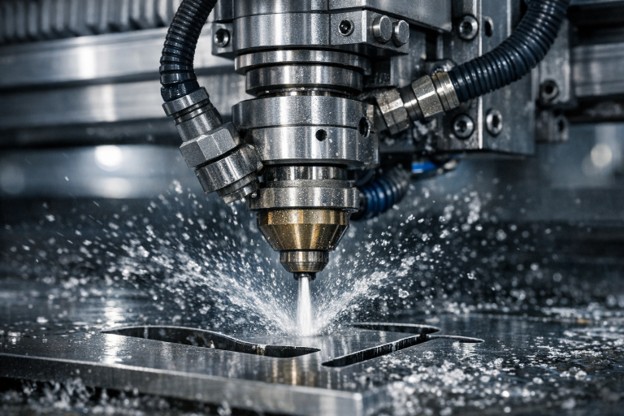
Most cutting processes are picky about what they can handle. A plasma torch only works on metals that conduct electricity. A laser is built mainly for metal and a few plastics. Ask either to switch from steel to foam to carbon fiber, and you quickly run into walls. A waterjet does not have those walls, which is exactly why so many shops reach for one.
Waterjet cutting materials span almost the entire shop floor — metal, foam, plastic, rubber, composites, glass, and stone — because a waterjet cuts by erosion, not heat. The same machine that slices thick steel plate will cut a foam insert without crushing it. This guide walks through the full range of what a waterjet handles, how thick it goes, the rare materials it is not ideal for, and how that versatility shows up across our waterjet cutting services.
How a Waterjet Cuts Almost Anything
A waterjet does not melt, burn, or vaporize material the way thermal methods do. It drives water through a tiny orifice at extreme pressure, mixes in garnet abrasive, and erodes a path through whatever is in front of it. It is mechanical removal, not a chemical or thermal reaction.
That mechanism is why the material list is so long. Because the cut does not depend on the material conducting electricity or absorbing a laser wavelength, the waterjet does not care what the material is made of. If abrasive water can erode it — and it can erode nearly everything — a waterjet can cut it.
Metals a Waterjet Cuts
Metal is the bread and butter of waterjet work. Carbon and stainless steel, aluminum, copper, brass, and bronze all cut cleanly, from thin sheet up to thick plate. The cut edge comes off square and clean, ready to use without the slag or dross that thermal methods leave behind.
It also handles the metals other processes find difficult. Hardened tool steels, titanium, and exotic aerospace alloys cut without the thermal stress that would harden or warp them. Reflective metals like copper and brass, which can give lasers trouble, are no problem for a waterjet.
Why Heat-Sensitive Metals Cut Best on a Waterjet
Some metals lose their value the moment heat touches them. Hardened steels, aluminum, and titanium all react badly to thermal cutting — edges harden and crack, parts warp, and properties shift along the cut. A waterjet adds no heat, so none of that happens.
This is the single biggest reason manufacturers switch processes for these alloys. The part keeps the exact properties you specified, all the way to the edge. We cover the underlying problem in detail in our guide to the heat-affected zone, but the short version is that cold cutting protects metals that heat would ruin.
Composites and Carbon Fiber
Composites are where a waterjet really separates from the pack. Carbon fiber, fiberglass, and layered composites are notoriously hard to cut without delaminating, fraying, or burning the resin. Thermal methods make all of those problems worse.
A waterjet cuts composites cleanly because it applies no heat and a controlled, even force. Edges stay crisp and the layers stay bonded. For aerospace and high-performance work that leans heavily on carbon fiber, this is often the only acceptable way to cut.
Plastics and Rubber
Plastics of nearly every kind cut well on a waterjet — acrylic, polycarbonate, nylon, UHMW, PVC, and more. Because there is no heat, the edges do not melt, gum up, or discolor the way they can under a laser. The cut is clean and dimensionally accurate.
Rubber and gasket materials cut the same way, which makes a waterjet a natural fit for gaskets, seals, and custom rubber parts. Soft, flexible materials that would deform under mechanical blades hold their shape under an abrasive stream.
Foam and Soft Materials
Foam might seem like the opposite of thick steel, but the same machine handles both. Closed-cell and open-cell foams, packaging inserts, and gasketing foams cut cleanly with crisp edges. The waterjet’s force is controllable enough to slice soft material without crushing or tearing it.
This is a common use that surprises people. Custom foam inserts for cases and packaging are a frequent waterjet job, cut to the same tight tolerances as a metal part.
Stone, Glass, Ceramic, and Tile
Hard, brittle materials round out the range. Stone, marble, granite, glass, ceramic, and tile all cut on a waterjet, which is why the process is a staple in architectural and decorative work as well as industrial fabrication.
The cold, controlled cut is gentle enough to avoid the cracking that mechanical tools often cause in brittle material. Intricate inlays and precise shapes that would shatter under other methods are achievable with abrasive waterjet.
Material Thickness: How Thick a Waterjet Cuts
Thickness is where a waterjet quietly outclasses thermal cutting. It cuts thin foil and sheet cleanly, then keeps going well into thick plate that a laser cannot touch and a plasma cuts only roughly.
Edge quality holds across that range rather than degrading as material thickens. The practical limit depends on the material and the finish you need, but for most shop work, thickness is rarely the thing that rules a waterjet out.
Waterjet Cutting Materials at a Glance
Here is the range in one view.
| Material Group | Examples | Waterjet Fit |
| Standard metals | Steel, stainless, aluminum, copper, brass | Excellent, clean edges |
| Heat-sensitive metals | Titanium, hardened steel, aerospace alloys | Excellent, no heat distortion |
| Composites | Carbon fiber, fiberglass, laminates | Excellent, no delamination |
| Plastics and rubber | Acrylic, polycarbonate, nylon, gasket stock | Excellent, no melted edges |
| Foam | Packaging inserts, gasket foam | Excellent, crisp edges |
| Stone and glass | Marble, granite, glass, ceramic, tile | Very good, minimal cracking |
The Few Materials a Waterjet Isn’t Ideal For
Honesty matters, so here are the exceptions. Tempered glass cannot be cut — it shatters by design the moment it is breached. Some very thin, delicate electronics and certain laminates can be sensitive to the moisture or the abrasive, and a few materials are simply faster and cheaper to cut another way.
These are edge cases, not the rule. For the overwhelming majority of materials a manufacturer works with, a waterjet is either the best option or a strong one. When it is not the right call, a good shop will tell you so.
Why Material Versatility Saves You Money
The real payoff of this range is consolidation. One waterjet covers work that might otherwise require a laser, a plasma table, and specialty equipment for composites or stone. That means fewer vendors, fewer handoffs, and one source for mixed-material jobs.
It also means a single shop can handle your steel brackets, your foam inserts, and your carbon fiber panels on the same machine, to the same tolerances. For how that versatility compares against thermal cutting on any single material, see our guide to waterjet vs. laser cutting.
Cut Your Material, Whatever It Is
From thick steel plate to delicate foam, from titanium to carbon fiber to marble, a waterjet handles a material range no thermal process can match — and it does it without heat, slag, or distortion. If you have a material you are not sure how to cut, that is exactly the kind of job a waterjet was built for. FP Waterjet is founder-led and based in Landrum, South Carolina, serving the Greenville-Spartanburg and Asheville corridor. Send us your CAD files and material specs and we will tell you straight whether waterjet is the right cut.
FP Waterjet is a founder-led abrasive waterjet cutting shop in Landrum, South Carolina, serving Upstate manufacturers with clean, distortion-free cuts and fast, local turnaround.
About the Author
Chris Urban is the Founder of Forged Path Automation. His 26+ year manufacturing career spans from an international manufacturing specialist trained in Zurich, Switzerland, to corporate President and business owner. Before launching Forged Path Automation (FPA), Chris scaled an industrial gas turbine business unit from its infancy to $50M in value, directed the zero-downtime relocation of 100+ industrial machines to a 150,000 sq. ft. Center of Excellence, and led US operations for a $2.3B global firm.
Today, Chris leverages his deep technical roots and an MBA to deliver precision waterjet cutting services, dependable production capacity, and rapid turnaround times for local and national manufacturers spanning from single prototypes to full production runs. He holds an advanced background in both the technical and financial sides of manufacturing, combining studies in Applied Science with a Master of Business Administration.
Connect with Chris on LinkedIn to talk shop or discuss your production needs.
Follow Forged Path Waterjet on LinkedIn or visit FPWaterjet.com.