
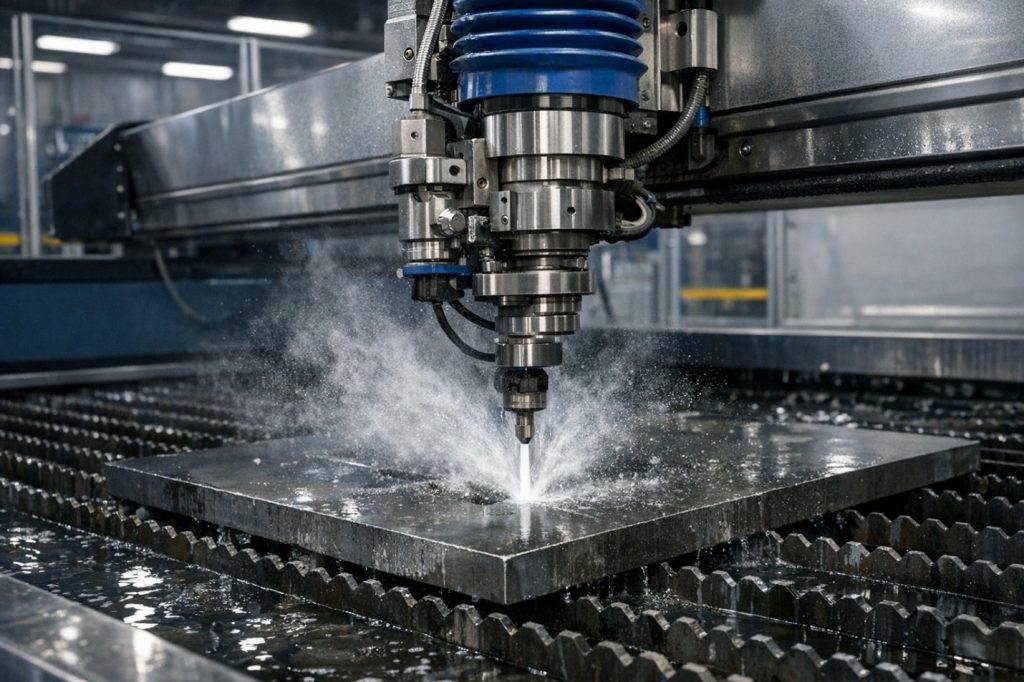
It is the first question almost everyone asks: what does waterjet cutting cost? The honest answer is that there is no single number, because two jobs that take the same time on the table can cost very different amounts. A quote is built from the specifics of your part, not from a sticker price. Understanding what moves the number helps you plan a job, compare quotes fairly, and avoid surprises.
Waterjet cutting cost depends on a handful of factors — material, thickness, cut length, part complexity, and quantity — far more than on any single hourly rate. Shops typically price by the hour, by the linear inch of cut, or per finished part, but all of those trace back to the same underlying drivers. This guide breaks down each one so you know what you are paying for, and ties it back to the waterjet cutting services behind the quote.
How Waterjet Cutting Is Priced
Shops generally use one of three pricing models. An hourly rate charges for table time, often landing anywhere from roughly fifty dollars to several hundred per hour depending on the machine and the work. A per-linear-inch rate prices the total length of the cut path, which suits detailed parts. A per-part price rolls everything into a flat number for a known quantity.
None of these is inherently cheaper. They are just different ways of expressing the same cost drivers. What actually sets the price is what the job demands of the machine — and that comes down to the factors below.
Material Type and Its Effect on Cost
Material is one of the biggest levers. Harder, denser materials cut more slowly and consume more abrasive, which raises cost. A soft foam or thin plastic cuts quickly and cheaply; thick stainless or titanium takes longer and uses more consumables.
The material also affects the abrasive load, which matters because garnet abrasive is the single largest operating cost in waterjet cutting. The more abrasive a job consumes, the more it costs to run. Which material you choose is covered in our guide to waterjet cutting materials, and it directly shapes the quote.
Material Thickness and Cutting Time
Thickness drives cost mostly through speed. The thicker the material, the slower the jet has to travel to cut cleanly through it, and slower cutting means more machine time per part. A part in thin sheet might cut in seconds; the same shape in thick plate can take many times longer.
Thickness also raises abrasive consumption, compounding the effect. This is why a quote always asks for material thickness up front — it is one of the strongest predictors of how long a job will take.
Cut Length and Part Complexity
The total length of the cut path matters more than the size of the part. A simple rectangle has a short path. The same-size part full of intricate detail, tight corners, and interior cutouts has a much longer one, and every inch is cutting time.
Complexity adds cost in another way too. Intricate geometry can require slower speeds to hold accuracy through fine features. A part that looks small can carry a long, slow cut path once you account for all its detail.
Quantity and Nesting
Volume changes the math in your favor. Setup and programming are mostly one-time costs spread across the run, so the per-part price usually drops as quantity rises. A single prototype carries all of that overhead alone; a production run shares it.
Nesting helps too. Arranging parts efficiently on the sheet maximizes material yield and reduces waste, which lowers material cost per part. A shop that nests well gets more parts out of the same stock, and that saving flows back to you.
Tolerance and Edge-Quality Requirements
Tighter tolerances and finer edge quality cost more, because they require slower cutting. A waterjet can run faster when a rougher edge is acceptable and must slow down when a part needs a smooth, precise edge. The finish you actually need is worth specifying clearly.
Asking for tighter tolerances than the part requires quietly raises the price. A good shop will help you match the edge quality to the application rather than over-specifying and overpaying.
Setup, Programming, and File Prep
Before any cutting happens, your files have to be reviewed, the cut paths programmed, and the material set up. That is real time, and it shows up in the quote — especially on small runs where it is spread across few parts.
Clean, accurate CAD files reduce this cost. When a shop can program directly from good files without redrawing or fixing geometry, setup is faster and cheaper. Sending complete, correct files is the simplest way to keep a quote down.
Why “Cost Per Hour” Is the Wrong Number
It is tempting to compare cutting methods on hourly rate alone, but that number hides the real cost. Waterjet cuts more slowly than a laser on thin metal, so its hourly rate can look higher. The finished-part cost often tells the opposite story.
Because waterjet adds no heat, most parts need no secondary finishing — no grinding off a heat-affected edge, no straightening warped parts, no scrapping cracked ones. Those hidden costs pile up on thermal cutting and disappear with waterjet. The fair comparison is cost per finished, in-spec part, which we break down in our guide to waterjet vs. laser cutting.
What Drives a Waterjet Quote at a Glance
Here are the main cost drivers in one view.
| Factor | Effect on Cost | Why |
| Material type | Higher for hard, dense materials | Slower cutting, more abrasive |
| Thickness | Higher as thickness increases | Slower speed, more machine time |
| Cut length and complexity | Higher for long, intricate paths | More cutting time per part |
| Quantity | Lower per part at volume | Setup spread across the run |
| Tolerance and finish | Higher for tight specs | Requires slower, finer cutting |
| Setup and programming | Fixed cost per job | File prep and material setup |
How to Get an Accurate Quote
The fastest path to a real number is a good file and a clear spec. Send your CAD files or drawings, name the material and thickness, state the quantity, and note any tolerance or finish requirements. With those in hand, a shop can quote precisely rather than padding for unknowns.
A trustworthy quote should be clear and complete, with no hidden fees and no scope surprises after the fact. If a price comes back vague or full of caveats, that is worth questioning before you commit.
Why Local Cutting Costs Less Than It Looks
The quote is not the whole cost of a cut part. Out-of-state cutting adds shipping, transit time, and the coordination overhead of working with a distant vendor. Those costs are easy to overlook and they add up, especially on repeat work.
A local shop removes them. FP Waterjet cuts from our Landrum, South Carolina facility, serving the Greenville-Spartanburg and Asheville corridor without out-of-state logistics. For regional manufacturers, the total delivered cost is often lower even before the faster turnaround is counted.
Get a Clear Waterjet Cutting Cost
Waterjet cutting cost is not a mystery once you know the drivers: material, thickness, cut length, complexity, and quantity, weighed against the finished-part cost rather than an hourly rate. The best way to know what your job costs is to ask for a real quote on your real part. FP Waterjet is founder-led, locally operated, and direct from quote to delivery. Send us your CAD files and we will give you a clear, all-in price with no surprises.
FP Waterjet is a founder-led abrasive waterjet cutting shop in Landrum, South Carolina, serving Upstate manufacturers with clean, distortion-free cuts and fast, local turnaround.
About the Author
Chris Urban is the Founder of Forged Path Automation. His 26+ year manufacturing career spans from an international manufacturing specialist trained in Zurich, Switzerland, to corporate President and business owner. Before launching Forged Path Automation (FPA), Chris scaled an industrial gas turbine business unit from its infancy to $50M in value, directed the zero-downtime relocation of 100+ industrial machines to a 150,000 sq. ft. Center of Excellence, and led US operations for a $2.3B global firm.
Today, Chris leverages his deep technical roots and an MBA to deliver precision waterjet cutting services, dependable production capacity, and rapid turnaround times for local and national manufacturers spanning from single prototypes to full production runs. He holds an advanced background in both the technical and financial sides of manufacturing, combining studies in Applied Science with a Master of Business Administration.
Connect with Chris on LinkedIn to talk shop or discuss your production needs.
Follow Forged Path Waterjet on LinkedIn or visit FPWaterjet.com.