
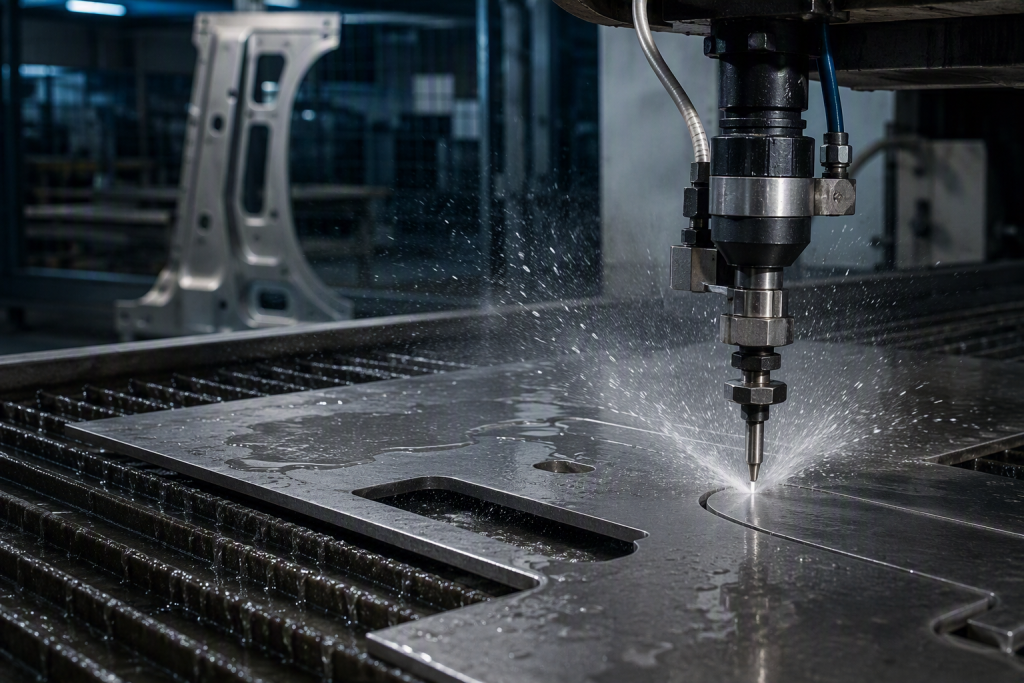
Forged Path Water Jet | Abrasive Waterjet Cutting in Landrum, South Carolina
The reason a B-pillar is made of press-hardened boron steel starts with a regulation. FMVSS No. 216a, Roof Crush Resistance, sets strength requirements for the passenger compartment roof. Its stated purpose is reducing deaths and injuries from the roof crushing into the occupant compartment during a rollover.
A roof structure has to hold its shape under load while the rest of the vehicle gets lighter. That combination is what pushed ultra-high-strength grades into the safety cage.
Where the Strength Actually Lives
Oak Ridge National Laboratory’s 2021 review of advanced high-strength steel describes the material selection plainly. Crumple zones want energy absorption over distance, so dual-phase and TRIP steels go there. The passenger compartment wants no intrusion at all. Martensitic, hot-formed, and dual-phase grades above 980 MPa carry that structure.
Boron press-hardened steel sits at the top of that range, listed at 1,700 MPa tensile strength. ORNL lists third-generation grades at 2,000 MPa.
Here is the part that gets skipped. Boron is alloyed into these steels for hardenability. Quenching a hot-stamped part in water-cooled dies then transforms austenite into martensite. The blank is not strong. The process makes it strong. The strength is a phase, held in place by a cooling history.
Reheat a region of that part and you are back on the same phase diagram, running the other way.
What the Softening Data Shows
ORNL’s measurements put numbers on it. In welded joints, the heat-affected zone of boron press-hardened steel loses up to 40 to 50 percent of its hardness. Grades below 700 MPa show minimal softening. The degree of softening rises with the strength of the base metal.
The mechanism sits below the melting point. Welding heat tempers the martensite and bainite that carried the strength rather than melting them. The wider argument runs in The Automotive Heat Affected Zone Is a Metallurgy Problem, Not a Finish Problem.
For a shop quoting flat parts in these grades, the practical reading is short. The money paid for that grade buys microstructure. The cutting process either preserves it or spends part of it.
Why More Parts Are Arriving in These Grades
The Department of Energy’s Transportation Technologies Office reports that a 10 percent reduction in vehicle weight can yield a 6 to 8 percent fuel economy improvement. Replacing cast iron and traditional steel with lightweight materials can cut body and chassis weight by up to 50 percent. Its published table puts advanced high-strength steel at 15 to 25 percent mass reduction.
Down-gauging is the whole point. Stronger steel at thinner section carries the same load. Thin, hard, flat stock is exactly the geometry that lands in a job shop. It is also the geometry with the least surrounding material to absorb a thermal cut.
Questions Worth Asking Before the Cut
What grade, in what condition? A part in the as-delivered hardened state has different exposure than a blank that will be hot-stamped afterward.
Where do the loads run? An edge in a low-stress region carries different risk than one at a fatigue-loaded feature. A fastener line is different again.
What happens downstream? A cut edge that gets welded later is about to see a second thermal cycle anyway.
There is an honest trade here. Waterjet runs slower than laser on thin mild steel. Cold cutting is not the answer to every job. On hardened and press-hardened grades, the question moves from cutting speed to edge condition.
Composite and multi-material parts run on a different failure mechanism, covered in Automotive Composite Parts: Where Edge Damage Actually Costs You.
Forged Path Water Jet: Abrasive Waterjet Cutting in Landrum, SC
Forged Path Water Jet cuts metal, foam, and plastic on an abrasive waterjet in Landrum, South Carolina, serving the Greenville, Spartanburg, and Asheville areas. Waterjet cuts cold, so parts come off the table without a heat affected zone.
Our Services Include:
- Automotive Waterjet Cutting — Cold cutting for brackets, gaskets, and prototype parts in hardened and heat-treated stock
- General Manufacturing Waterjet Cutting — Sheet and plate work from one-off prototypes through production runs
Have a part to cut?
Get a price on your part from your CAD file or drawing.
About the Author
Chris Urban is the Founder of Forged Path Automation. His 26+ year manufacturing career spans from an international manufacturing specialist trained in Zurich, Switzerland, to corporate President and business owner. Before launching Forged Path Automation (FPA), Chris scaled an industrial gas turbine business unit from its infancy to $50M in value, directed the zero-downtime relocation of 100+ industrial machines to a 150,000 sq. ft. Center of Excellence, and led US operations for a $2.3B global firm. Today, Chris leverages his deep technical roots and an MBA to engineer turnkey robotic finishing cells that deliver total production stability and clear ROI for high-mix manufacturers. Chris holds an advanced background in both the technical and financial sides of manufacturing, combining studies in Applied Science with a Master of Business Administration.
Connect with Chris on LinkedIn to talk shop or discuss your floor’s ROI.
Follow FP Waterjet on LinkedIn or visit FPWaterjet.com.
Works Cited
Quick Reference Guide (2010 Version) to Federal Motor Vehicle Safety Standards and Regulations. DOT HS 811 439, National Highway Traffic Safety Administration, Feb. 2011, www.nhtsa.gov/sites/nhtsa.gov/files/fmvss-quickrefguide-hs811439.pdf. Accessed 12 Sept. 2026.
“Lightweight Materials for Cars and Trucks.” Transportation Technologies Office, U.S. Department of Energy, 18 May 2026, www.energy.gov/cmei/vehicles/lightweight-materials-cars-and-trucks. Accessed 12 Sept. 2026.