
Forged Path Water Jet | Abrasive Waterjet Cutting in Landrum, South Carolina
Motor vehicle output is moving against the rest of the factory floor. The Federal Reserve’s G.17 release of August 18, 2026 tells the story. Durable goods production rose 0.7 percent in July. Most categories inside that number expanded by more than 1.0 percent. Motor vehicles and parts fell 2.1 percent, one of only two durable categories to decline.
For a supplier, that gap reframes the competitive question. Fewer programs are moving, so the ones still moving get scrutinized harder. Scrap, rework, and dimensional drift stop being annoyances and start being the reason a quote loses.
Which raises a cost that rarely appears on a quote at all.
The Part Was Specified as a Microstructure
An engineer does not specify strength. An engineer specifies a material whose microstructure produces strength. The mill built that microstructure through controlled heating and cooling.
Oak Ridge National Laboratory’s 2021 review of advanced high-strength steel sets out what happens when heat returns. Three regions form around a weld. The fusion zone passes the melting point. The heat-affected zone stays below melting, yet climbs high enough to change microstructure. Past that sits untouched base metal.
The heat-affected zone is where hardened phases get tempered. ORNL reports softening of up to 40 to 50 percent in hardness for boron press-hardened steel. That grade arrives at roughly 1,700 MPa tensile strength. Grades below 700 MPa show minimal softening. Both the degree of softening and the size of the softened region track base metal strength.
That last sentence is the one worth sitting with. The stronger the steel a designer specifies, the more a thermal process gives back.
ORNL measured welds rather than cut edges, and the distinction is real. What carries across is the mechanism. Peak temperature and cooling rate rewrite microstructure below the melting point. Any process driving that band into the material works under the same physics. The scale changes with the heat input. The mechanism does not.
The Material Mix Is Moving Toward the Problem
This would matter less if vehicles were still built from mild steel. They are not. ORNL puts steel at roughly 65 percent of an average automobile’s weight, about 900 kg per vehicle. Advanced high-strength steels now appear in nearly every new vehicle design. ORNL reports they are on a path to replace about 60 percent of the conventional high-strength steel in use.
Read as a materials forecast, that is unremarkable. Read as a processing forecast, it is pointed. Every grade on that path is more sensitive to thermal input than the steel it displaces. Advanced high-strength steel loses hardness. Aluminum alloys lose temper. Polymer composites lose matrix integrity long before the fibers notice anything.
The hardened and press-hardened case gets its own treatment in Cutting Advanced High Strength Steel Without Undoing the Heat Treatment.
Three Costs That Never Reach the Cutting Quote
Three consequences follow, and none of them show up as a line on the cutting quote.
Edge condition becomes an inspection item. A softened band along a cut edge is invisible to a caliper. It shows up later as a fatigue crack initiation site, or as a joint that underperforms its calculated capacity.
Secondary work eats the margin. Straightening, re-machining, and edge conditioning are all labor. All of it lands on material that already costs more than it did two years ago.
The process decision moves upstream. A designer who sees that the cutting method touches the specified property stops treating cutting as a purchasing decision. It becomes an engineering one.
Composites follow a parallel logic with a different failure mode, examined in Automotive Composite Parts: Where Edge Damage Actually Costs You.
The Argument for Taking Heat Out of the Cut
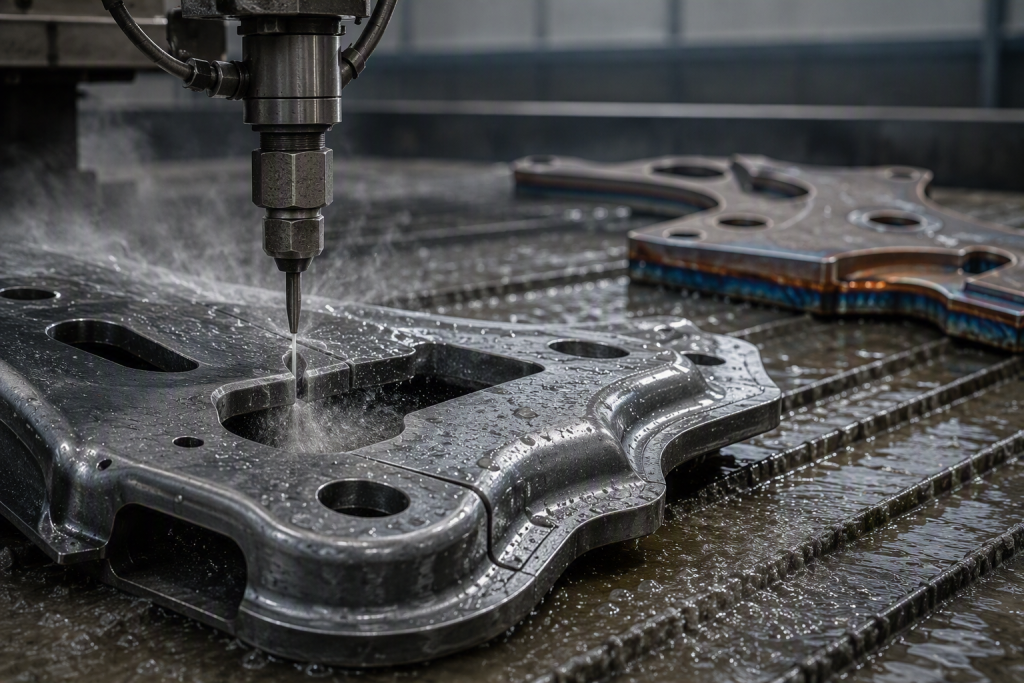
Abrasive waterjet cuts cold. Water and garnet abrasive remove material by erosion rather than melting. Parts come off the table with no heat affected zone. The microstructure at the edge is the microstructure the mill delivered.
That is a narrow claim, and it should stay narrow. Waterjet is slower than laser on thin mild steel. On plenty of parts a laser is the right answer. The calculation shifts when the value of the material sits in a heat treatment.
Forged Path Water Jet: Cold Cutting for Automotive Suppliers
Forged Path Water Jet cuts metal, foam, and plastic on an abrasive waterjet in Landrum, South Carolina, serving the Greenville, Spartanburg, and Asheville areas. Waterjet cuts cold, so parts come off the table without a heat affected zone.
Our Services Include:
- Automotive Waterjet Cutting — Gaskets, brackets, plate parts, and prototypes for automotive suppliers
- Waterjet Cutting Services — Sheet and plate cutting in metal, foam, and plastic, from one-off prototypes to production runs
Have a part to cut?
Send us your CAD file and we will quote the job.
About the Author
Chris Urban is the Founder of Forged Path Automation. His 26+ year manufacturing career spans from an international manufacturing specialist trained in Zurich, Switzerland, to corporate President and business owner. Before launching Forged Path Automation (FPA), Chris scaled an industrial gas turbine business unit from its infancy to $50M in value, directed the zero-downtime relocation of 100+ industrial machines to a 150,000 sq. ft. Center of Excellence, and led US operations for a $2.3B global firm. Today, Chris leverages his deep technical roots and an MBA to engineer turnkey robotic finishing cells that deliver total production stability and clear ROI for high-mix manufacturers. Chris holds an advanced background in both the technical and financial sides of manufacturing, combining studies in Applied Science with a Master of Business Administration.
Connect with Chris on LinkedIn to talk shop or discuss your floor’s ROI.
Follow FP Waterjet on LinkedIn or visit FPWaterjet.com.
Works Cited
“Industrial Production and Capacity Utilization — G.17.” Board of Governors of the Federal Reserve System, 18 Aug. 2026, www.federalreserve.gov/releases/g17/current/default.htm. Accessed 12 Sept. 2026.
Hu, Xiaohua, and Zhili Feng. Advanced High-Strength Steel—Basics and Applications in the Automotive Industry. ORNL/TM-2021/2047, Oak Ridge National Laboratory, Apr. 2021, info.ornl.gov/sites/publications/Files/Pub158668.pdf. Accessed 12 Sept. 2026.