
Forged Path Water Jet | Abrasive Waterjet Cutting in Landrum, South Carolina
Composites are the long game in vehicle lightweighting. Oak Ridge National Laboratory’s lightweight materials program describes the split directly. The short term runs on high-strength steel, aluminum, die cast magnesium, and glass fiber polymer composites. Wrought magnesium and carbon fiber composites offer greater mass reduction over a longer horizon. ORNL runs a DOE initiative on lower-cost carbon fiber, working on alternative precursors and more energy efficient conversion.
Cost is the barrier, and cost curves move. More composite parts reach Tier 1 and Tier 2 shops every year. Most of those shops apply metalworking instincts to a material that does not behave like metal.
The Assumption Worth Testing
The received wisdom on composites is that any delamination ruins the part. It is a reasonable instinct, and it drives real spending on tooling, backing plates, and inspection.
NASA tested it. In NASA/TM—2019—220134, A. T. Nettles at Marshall Space Flight Center prepared 16-ply quasi-isotropic carbon/epoxy specimens. Each carried one of four deliberate levels of hole quality, from jig-drilled down to deliberately damaged. All of them were then loaded in bearing.
The finding is counterintuitive. Average load at first load drop and ultimate load came out slightly higher for the jig-drilled holes. The report describes that increase as small and within scatter. That held even against holes it calls grotesquely bad. Nettles notes that no defect-free hole exists, since some chip-out of fibers occurs whatever the drill bit and backing plate pressure. The conclusion is that a simple visual inspection should suffice for holes carrying bearing loads.
The reason sits in the damage progression. Before the first load drop, a jig-drilled hole has already taken on damage comparable to the worst technique tested. The bolt makes its own damage, so machining quality stops mattering quickly.
One caveat belongs with that result. NASA was testing an aerospace laminate under a bolted bearing load, not an automotive layup under a service duty cycle. The finding is a reason to aim inspection effort, rather than a reason to stop caring about edges.
So Where Does Damage Cost Money
Edge and hole damage in composites is worth controlling in specific places, and chasing it everywhere is waste.
Fatigue-loaded features. Bearing strength under static load is one question. Cyclic life around a damaged edge is a different one, and the NASA study measured the first.
Sealing and bonding faces. A bonded joint or a gasket face is a surface-dependent feature. Fiber breakout at that surface changes the joint.
Moisture paths. A raw composite edge with disturbed plies is a moisture entry point. Service life is measured in years.
Matrix degradation. This is the failure mode with no bolt to redistribute the load. Heat damages the polymer matrix far below any temperature that would trouble the fibers. Degraded matrix does not show in a photograph.
That last one runs on the same logic as hardened steel, laid out in The Automotive Heat Affected Zone Is a Metallurgy Problem, Not a Finish Problem.
The Multi-Material Complication
Composite parts rarely stay alone. ORNL’s program includes multi-material enabling work. That means joining methods and inspection techniques for dissimilar material stacks, because that is how real bodies get built.
A bracket bolting a composite panel to a press-hardened steel structure is two thermal sensitivities meeting at one joint. The grade-specific side of that pairing runs in Cutting Advanced High Strength Steel Without Undoing the Heat Treatment.
Where Cold Cutting Fits
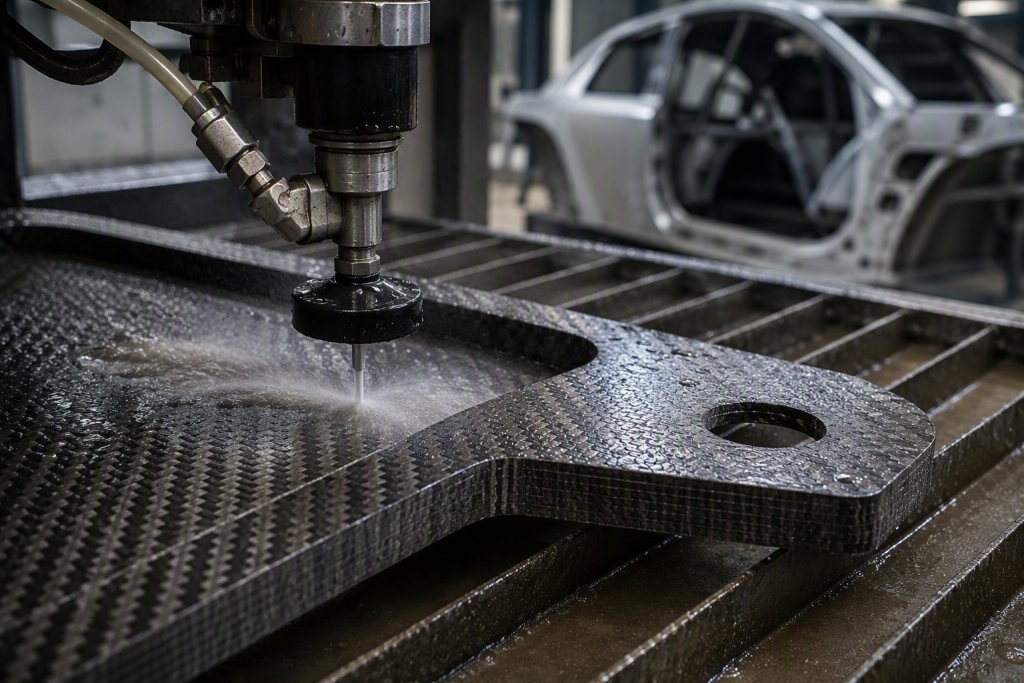
Abrasive waterjet cuts composites without adding heat to the matrix. Water and garnet erode material rather than melting it. Thermal matrix degradation comes off the list of things to watch at the cut edge.
That is not the same as a perfect edge. Composites can still show fiber pull-out. Edge quality depends on the layup, the thickness, and the cut setup. Cold cutting removes one specific failure mode. It happens to be the one that hides from visual inspection.
Forged Path Water Jet: Cold Cutting for Composites and Exotic Materials
Forged Path Water Jet cuts metal, foam, and plastic on an abrasive waterjet in Landrum, South Carolina, serving the Greenville, Spartanburg, and Asheville areas. Waterjet cuts cold, so parts come off the table without a heat affected zone.
Our Services Include:
- Aerospace Waterjet Cutting — Cold cutting for materials that cannot take heat from a laser or plasma torch
- Waterjet Cutting Services — Sheet and plate cutting in metal, foam, and plastic, prototype through production
Have a part to cut?
Request a quote and send us your CAD file or drawing.
Works Cited
“Lightweight Materials.” Oak Ridge National Laboratory, www.ornl.gov/content/lightweight-materials. Accessed 12 Sept. 2026.
Nettles, A. T. The Effect of Hole Quality on the Bearing Strength of Carbon Fiber Laminates. NASA/TM—2019—220134, NASA Marshall Space Flight Center, May 2019, ntrs.nasa.gov/api/citations/20190027642/downloads/20190027642.pdf. Accessed 12 Sept. 2026.