
Forged Path Water Jet | Abrasive Waterjet Cutting in Landrum, South Carolina
Cold cutting vs thermal cutting is a material decision before it is a price decision. In the Upstate, that decision comes up often, because the local automotive supply base works in many materials.
Preliminary Bureau of Labor Statistics data puts Greenville metro manufacturing employment at 61.9 thousand jobs in August 2026. That is up 1.8% from August 2025. Forged Path Water Jet cuts metal, foam, and plastic on an abrasive waterjet in Landrum, South Carolina, serving manufacturers across the Greenville, Spartanburg, and Asheville areas.
An Upstate Supply Base Built on Many Materials
The Upstate SC Alliance major-employer list, compiled in February 2026, shows how wide that base is. By our count, 17 of the manufacturers on it build vehicles, tires, or automotive parts. Gestamp makes metal stampings and welded assemblies in Union County. Benteler builds chassis components and axles in Spartanburg County. Yanfeng makes interior components in Laurens County, and SAGE Automotive Interiors produces automotive fabrics.
Stamped steel, axle components, and interior parts do not share a cutting process. So a fixture, prototype, or replacement part for these plants starts with one question. Can this material take heat at the cut?
What Is the Difference Between Cold Cutting and Thermal Cutting?
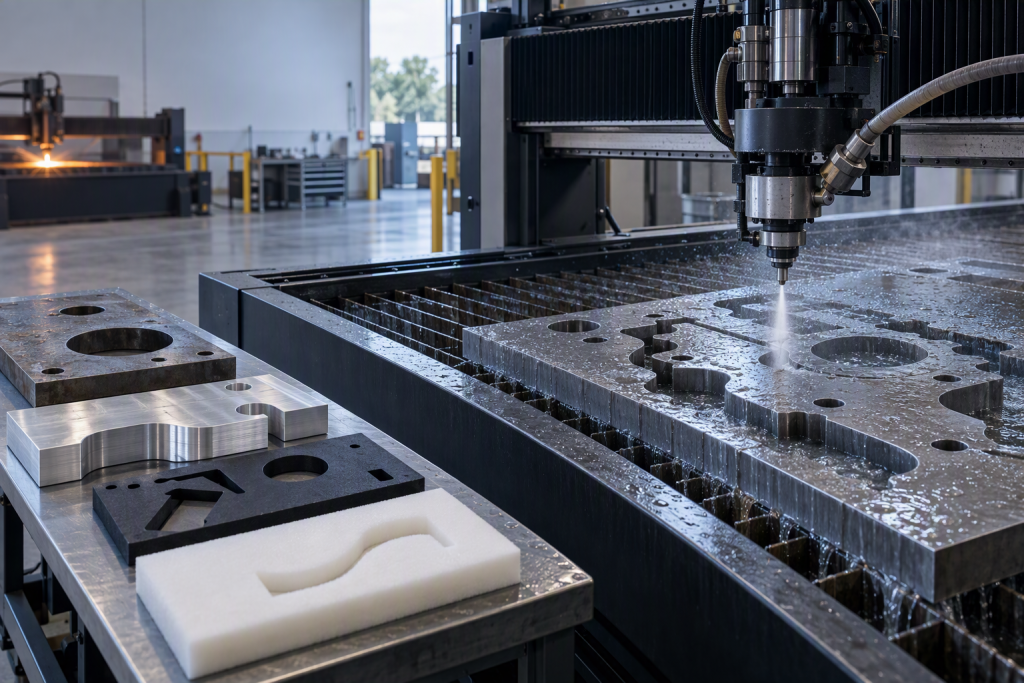
Thermal cutting uses heat to melt, burn, or vaporize material along the cut path, as laser, plasma, and oxyfuel cutting do. Cold cutting removes material without heat at the cut. Abrasive waterjet is a cold process: high pressure water mixed with garnet abrasive erodes the material, so the cut edge has no heat affected zone.
Cold Cutting vs Thermal Cutting by Material
Carbon and alloy steel. Thermal processes cut steel plate well, and for a part that gets welded or painted, a heat-affected edge may not matter. The answer changes when the steel has been hardened, or when holes and machined features sit near the cut edge. Heat at that edge can undo the properties the heat treatment was meant to set.
Stainless steel and aluminum. Both conduct electricity, so plasma and laser can cut them. Stainless also raises a fume question during hot work. Our comparison of waterjet vs plasma cutting covers that tradeoff for fixture and tooling plate.
Plastics and foam. Heat melts or chars many plastics and foams at the cut edge. Cold processes avoid that. CNC routing is the other common non-thermal option, and it works by cutting tool contact rather than an abrasive stream. Our breakdown of waterjet vs CNC routing compares the two for foam and plastic parts.
Composites. Heat can degrade the resin that binds a composite together. That is why cold cutting is a common choice for carbon fiber and glass fiber parts.
Mixed orders. A tooling order may combine steel plate, plastic wear pads, and foam gaskets. Because waterjet does not rely on heat or electrical conductivity, one machine cuts all three from the same drawing set.
Is Cold Cutting the Right Choice for Every Part?
No. Thermal cutting is often the practical choice for conductive metal parts whose edges will be welded, ground, or painted, where a heat-affected edge does no harm. Cold cutting earns its place when features sit near the edge, when the material is hardened or heat-sensitive, or when one order mixes metal, foam, and plastic.
Speed belongs in any honest look at cold cutting vs thermal cutting. Waterjet is slower than laser on thin sheet steel. The right process is the one that yields a usable part with the fewest secondary steps. That is not necessarily the fastest cut on the table.
Five Questions Before Choosing Cold Cutting vs Thermal Cutting
Is the material conductive? Plasma needs an electrically conductive workpiece. Foam, plastic, and many composites rule it out.
Has it been hardened or heat-treated? If so, heat at the edge is a metallurgy question, not a cosmetic one.
Will features sit near the cut edge? Holes, slots, and tapped features close to a thermal edge land in material the heat has changed.
What happens to the edge next? An edge headed for welding or heavy machining tolerates more than an edge that stays as cut.
Does the order mix materials? One cold process keeps metal, foam, and plastic pieces on one quote and one schedule.
Forged Path Water Jet: Abrasive Waterjet Cutting in Landrum, SC
Forged Path Water Jet cuts metal, foam, and plastic on an abrasive waterjet in Landrum, South Carolina, serving the Greenville, Spartanburg, and Asheville areas. Waterjet cuts cold, so parts come off the table without a heat affected zone.
Our Services Include:
- Waterjet Cutting Services — Sheet and plate cutting in metal, foam, and plastic, from one-off prototypes to production runs
- Aerospace Waterjet Cutting — Cold cutting for materials that cannot take heat from a laser or plasma torch
Have a part to cut?
Send us your CAD file and we will quote the job.
Works Cited
U.S. Bureau of Labor Statistics. “Greenville-Mauldin-Easley, SC: Economy at a Glance.” U.S. Department of Labor, www.bls.gov/eag/eag.sc_greenville_msa.htm. Accessed 11 Oct. 2026.
Upstate SC Alliance. “Major Employers in Upstate SC.” Upstate SC Alliance, compiled 9 Feb. 2026, www.upstatescalliance.com/major-employers/. Accessed 11 Oct. 2026.
Related Articles
- Waterjet vs Plasma Cutting: Choosing a Process for Fixture and Tooling Plate
- Waterjet vs CNC Routing for Foam and Plastic Parts
About the Author
Chris Urban is the Founder of Forged Path Automation. His 26+ year manufacturing career spans from an international manufacturing specialist trained in Zurich, Switzerland, to corporate President and business owner. Before launching Forged Path Automation (FPA), Chris scaled an industrial gas turbine business unit from its infancy to $50M in value, directed the zero-downtime relocation of 100+ industrial machines to a 150,000 sq. ft. Center of Excellence, and led US operations for a $2.3B global firm. Today, Chris leverages his deep technical roots and an MBA to engineer turnkey robotic finishing cells that deliver total production stability and clear ROI for high-mix manufacturers. Chris holds an advanced background in both the technical and financial sides of manufacturing, combining studies in Applied Science with a Master of Business Administration.
Connect with Chris on LinkedIn to talk shop or discuss your floor’s ROI.
Follow Forged Path Automation on LinkedIn or visit ForgedPathAutomation.com.