
Forged Path Water Jet | Abrasive Waterjet Cutting in Landrum, South Carolina
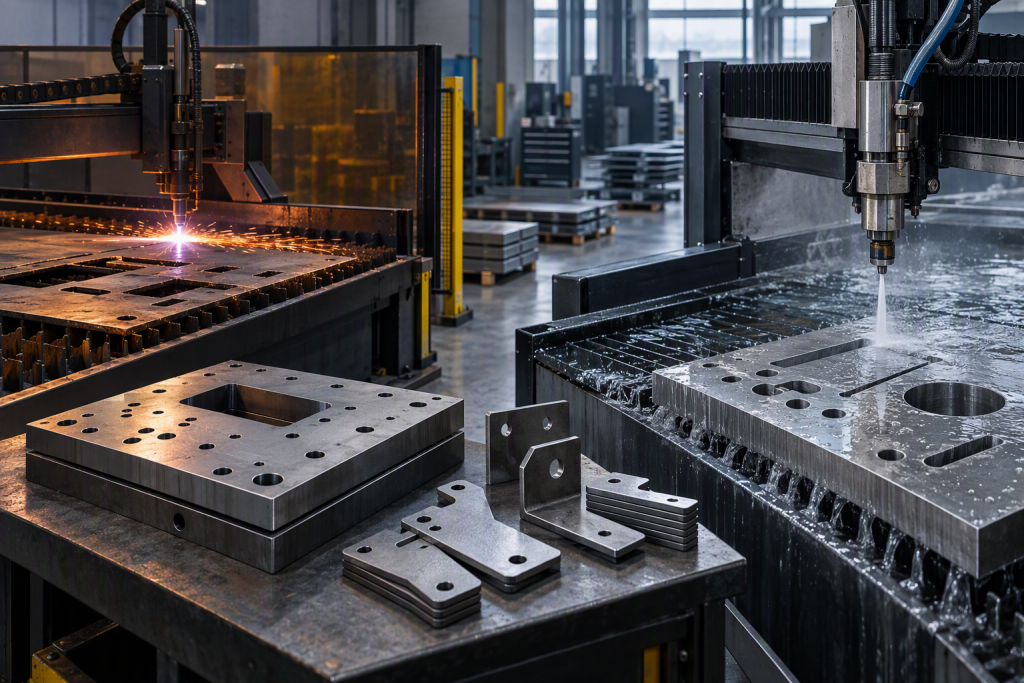
Waterjet vs plasma cutting is one of the first decisions on any fixture or tooling plate. Fixture bases, riser plates, and bracket blanks for automotive lines all start as flat stock. The cut sets up every step that follows, from drilling and tapping to final assembly on the line.
Both processes cut from a CAD file. They differ in heat, material range, and the edge they leave behind. Forged Path Water Jet cuts metal, foam, and plastic on an abrasive waterjet in Landrum, South Carolina, serving manufacturers across the Greenville, Spartanburg, and Asheville areas.
This article is part of our guide to cold cutting vs thermal cutting, which covers the same decision across steel, aluminum, plastic, foam, and composites.
How Plasma Cuts
Plasma uses an electric arc and ionized gas to melt metal along the cut path. The Open University’s OpenLearn reference on plasma arc cutting, last updated in February 2018, describes it as a process for conductive materials. Its list includes mild steel, stainless steel, aluminum, copper, brass, and titanium. It gives a usual working range of 5 to 25 mm. Much thinner and much thicker cuts are possible.
Plasma is a practical process for a lot of fabrication work. For a bracket blank that will be welded, ground, and painted, a thermal edge may not matter at all.
How Abrasive Waterjet Cuts
An abrasive waterjet mixes high pressure water with garnet abrasive and erodes material along the cut path. Waterjet cuts cold, so there is no heat affected zone. The process does not depend on electrical conductivity, which is why the same machine cuts metal, foam, and plastic.
Waterjet vs Plasma Cutting on Fixture and Tooling Plate
Heat at the edge. OpenLearn notes that plasma can leave a heat-affected zone up to 5 mm deep, depending on material, thickness, and cutting speed. On a fixture plate, that zone sits right where locating holes and tapped features tend to go.
Edge angle. The same reference puts plasma’s typical side taper at 2 to 7 degrees. Careful control of cutting parameters can bring that down to 1 to 2 degrees. Waterjet edges carry taper as well, so ask any shop how it manages taper for your material and thickness.
Dross. OpenLearn flags dross stuck to the underside of a plasma cut as an occasional problem. Dross adds a cleanup step before a plate can sit flat on a fixture base.
Inside corners. OpenLearn lists a minimum corner radius of 4 mm on thin sheet for plasma, rising as cutting speed increases. Fixture nests and pockets with tight inside corners are worth checking against that limit before the drawing is released.
Material range. Plasma needs a conductive workpiece. Fixture work often includes non-metal pieces, such as plastic wear pads or foam gaskets. A waterjet cuts those on the same table as the steel.
Is Plasma or Waterjet Better for Stainless Fixture Plate?
For stainless fixture plate that will be machined, abrasive waterjet is usually the stronger fit because it cuts cold and leaves no heat-affected zone. Plasma is hot work, and OSHA identifies hot work on stainless and other chromium-bearing steels as a major source of hexavalent chromium exposure.
Can Plasma Cut Foam or Plastic Fixture Parts?
No. Plasma cutting needs an electrically conductive workpiece, so it cannot cut foam or plastic. An abrasive waterjet does not depend on conductivity. Forged Path Water Jet in Landrum, South Carolina, cuts metal, foam, and plastic on the same machine. A mixed fixture order can stay on one quote.
For foam and plastic parts on their own, the more useful comparison is a mechanical one. Our breakdown of waterjet vs CNC routing compares the two for gaskets, dunnage inserts, and plastic panels.
Waterjet vs Plasma Cutting: A Simple Way to Choose
Choose plasma when the part is conductive, the edge will be welded or heavily machined, and a thermal edge is acceptable on the drawing.
Choose waterjet when holes or features sit close to the cut edge, when the material is heat-sensitive or non-conductive, or when one order mixes metal, plastic, and foam.
Ask before you decide if the plate is hardened or heat-treated. In that case, heat at the edge is a metallurgy question, not a cosmetic one.
Forged Path Water Jet: Abrasive Waterjet Cutting in Landrum, SC
Forged Path Water Jet cuts metal, foam, and plastic on an abrasive waterjet in Landrum, South Carolina, serving the Greenville, Spartanburg, and Asheville areas. Waterjet cuts cold, so parts come off the table without a heat affected zone.
Our Services Include:
- Waterjet Cutting Services — Sheet and plate cutting in metal, foam, and plastic, from one-off prototypes to production runs
- Aerospace Waterjet Cutting — Cold cutting for materials that cannot take heat from a laser or plasma torch
Have a part to cut?
Send us your CAD file and we will quote the job.
Works Cited
Occupational Safety and Health Administration. “Hexavalent Chromium – Overview.” U.S. Department of Labor, www.osha.gov/hexavalent-chromium. Accessed 11 Oct. 2026.
The Open University. “Plasma Arc Cutting.” OpenLearn, 7 Feb. 2018, www.open.edu/openlearn/science-maths-technology/engineering-technology/manupedia/plasma-arc-cutting. Accessed 11 Oct. 2026.
Related Articles
- Cold Cutting vs Thermal Cutting: Matching the Process to the Material
- Waterjet vs CNC Routing for Foam and Plastic Parts
About the Author
Chris Urban is the Founder of Forged Path Automation. His 26+ year manufacturing career spans from an international manufacturing specialist trained in Zurich, Switzerland, to corporate President and business owner. Before launching Forged Path Automation (FPA), Chris scaled an industrial gas turbine business unit from its infancy to $50M in value, directed the zero-downtime relocation of 100+ industrial machines to a 150,000 sq. ft. Center of Excellence, and led US operations for a $2.3B global firm. Today, Chris leverages his deep technical roots and an MBA to engineer turnkey robotic finishing cells that deliver total production stability and clear ROI for high-mix manufacturers. Chris holds an advanced background in both the technical and financial sides of manufacturing, combining studies in Applied Science with a Master of Business Administration.
Connect with Chris on LinkedIn to talk shop or discuss your floor’s ROI.
Follow Forged Path Automation on LinkedIn or visit ForgedPathAutomation.com.