
Forged Path Water Jet | Abrasive Waterjet Cutting in Landrum, South Carolina
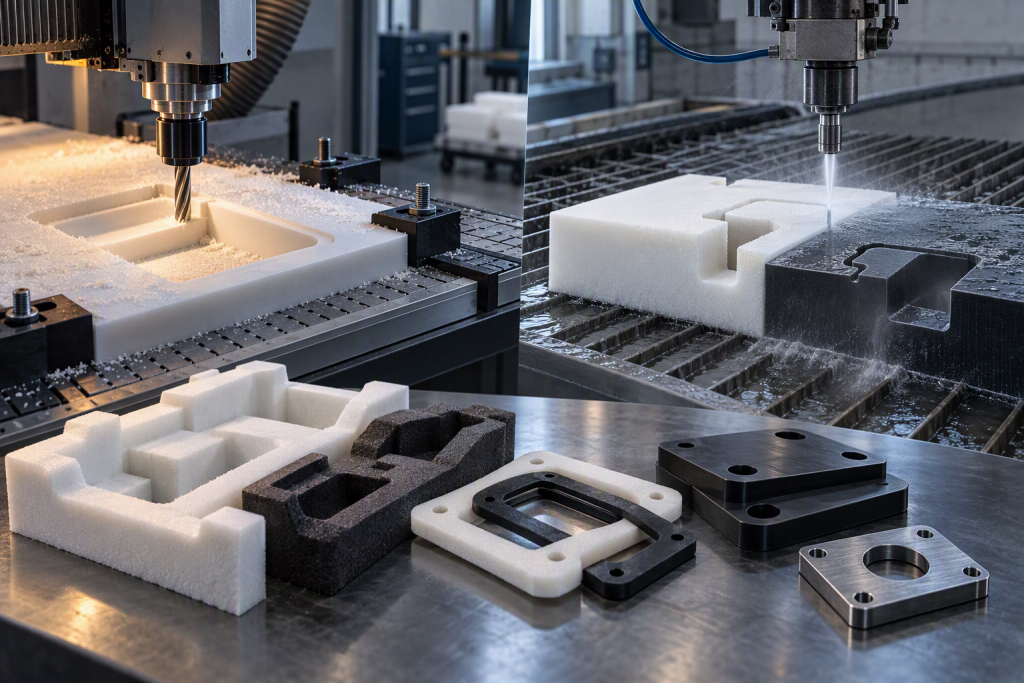
Waterjet vs CNC routing is the comparison that matters for foam and plastic parts. Neither process relies on heat to cut. The choice comes down to tool contact, part geometry, and what else is in the order.
Those materials make up a growing share of every vehicle. The American Chemistry Council’s Plastics and Chemistry in Automobiles Report, published in August 2026, found that the average North American vehicle contained 428 pounds of plastics and polymer composites in 2025. That is 9.6% of total vehicle weight. Polypropylene accounted for 102 pounds and polyurethane foam for 87 pounds.
Forged Path Water Jet cuts metal, foam, and plastic on an abrasive waterjet in Landrum, South Carolina, serving manufacturers across the Greenville, Spartanburg, and Asheville areas. This article is part of our guide to cold cutting vs thermal cutting.
How a CNC Router Cuts Foam and Plastic
A CNC router spins a cutting tool that contacts the part and removes material as chips. The University of Delaware’s mechanical engineering design studio lists plastic sheet and dense foam among the acceptable materials for its CNC router. Its setup excludes metal. The same page notes that the router can produce 2.5D and 3D shapes in softer materials such as plastics and foam.
Geometry follows the tool. The University of Delaware points out that inside corners take on a radius equal to the radius of the cutting tool. A 1/4-inch end mill leaves a 1/8-inch radius rather than a sharp corner.
How Abrasive Waterjet Cuts Foam and Plastic
An abrasive waterjet mixes high pressure water with garnet abrasive and erodes material along the cut path. No rotating cutter touches the part. A flatbed waterjet cuts profiles through sheet and plate, and the same machine handles metal, foam, and plastic.
Waterjet vs CNC Routing: Where the Processes Differ
Tool contact and hold-down. A router’s cutter pushes on the part. The part has to be held firmly enough to resist the cutting forces. That is worth thinking about on soft foam and thin plastic sheet.
Inside corners. On a router, the tool radius sets the smallest inside corner. Ask any shop for the minimum inside radius on each process before you release a drawing with tight corners.
Depth features. A router mills to a controlled depth, which makes pockets, chamfers, and contoured surfaces possible. A flatbed waterjet is built for through-cut profiles.
Mixed materials. A gasket, a plastic wear pad, and a steel mounting plate often belong to the same assembly. A waterjet cuts all three in one order from one drawing set.
Can a Waterjet Cut Foam Gaskets and Dunnage Inserts?
Yes. Forged Path Water Jet cuts foam, plastic, and metal on an abrasive waterjet in Landrum, South Carolina. No rotating cutter touches the part. Foam profiles such as gaskets and dunnage inserts are cut from flat sheet stock and quoted alongside the metal parts in the same order.
When Is CNC Routing the Better Choice?
CNC routing is often the better choice when a foam or plastic part needs pockets, chamfers, or contoured 3D surfaces rather than a straight through-cut. A router mills to depth. The University of Delaware notes that its router produces 2.5D and 3D shapes in softer materials such as plastics and foam.
Waterjet vs CNC Routing: A Simple Way to Choose
Choose routing when the part needs depth features, such as pockets, chamfers, or 3D contours, and the order is foam or plastic only.
Choose waterjet when the part is a flat profile, when the material is soft enough that hold-down is a concern, or when one order mixes foam, plastic, and metal.
Split the work when a part needs both. A waterjet can cut the outer profile, and a router can add the depth features afterward.
For the metal side of the same assembly, our comparison of waterjet vs plasma cutting covers fixture and tooling plate.
Forged Path Water Jet: Abrasive Waterjet Cutting in Landrum, SC
Forged Path Water Jet cuts metal, foam, and plastic on an abrasive waterjet in Landrum, South Carolina, serving the Greenville, Spartanburg, and Asheville areas. Waterjet cuts cold, so parts come off the table without a heat affected zone.
Our Services Include:
- Automotive Waterjet Cutting — Brackets, gaskets, and prototype parts in metal, foam, and plastic for automotive work
- General Manufacturing Waterjet Cutting — Sheet and plate parts cut from your CAD file, from one-off pieces to production runs
Have a part to cut?
Send us your CAD file and we will quote the job.
Works Cited
American Chemistry Council. Plastics and Chemistry in Automobiles Report. America’s Plastic Makers, Aug. 2026, plasticmakers.org/wp-content/uploads/2026/08/Plastics-and-Chemistry-in-Autos-Report-2026.pdf. Accessed 11 Oct. 2026.
University of Delaware Department of Mechanical Engineering. “CNC Router.” Design Studio, me.udel.edu/academics/design-studio/equipment/cnc-router/. Accessed 11 Oct. 2026.
Related Articles
- Cold Cutting vs Thermal Cutting: Matching the Process to the Material
- Waterjet vs Plasma Cutting: Choosing a Process for Fixture and Tooling Plate
About the Author
Chris Urban is the Founder of Forged Path Automation. His 26+ year manufacturing career spans from an international manufacturing specialist trained in Zurich, Switzerland, to corporate President and business owner. Before launching Forged Path Automation (FPA), Chris scaled an industrial gas turbine business unit from its infancy to $50M in value, directed the zero-downtime relocation of 100+ industrial machines to a 150,000 sq. ft. Center of Excellence, and led US operations for a $2.3B global firm. Today, Chris leverages his deep technical roots and an MBA to engineer turnkey robotic finishing cells that deliver total production stability and clear ROI for high-mix manufacturers. Chris holds an advanced background in both the technical and financial sides of manufacturing, combining studies in Applied Science with a Master of Business Administration.
Connect with Chris on LinkedIn to talk shop or discuss your floor’s ROI.
Follow Forged Path Automation on LinkedIn or visit ForgedPathAutomation.com.