
FP Waterjet — Precision Waterjet Cutting from Landrum, SC
At 12:01 a.m. eastern daylight time on April 6, 2026, the way the federal government taxes imported metal changed in a way most shop floors have not fully priced in.
Proclamation 11021, signed April 2 and published at 91 FR 18201, directs that Section 232 duties on aluminum, steel, and copper apply to the full customs value of the imported product, regardless of metal content. The old approach taxed only the declared value of the metal inside a part. The new one taxes the whole thing.
For a Carolina manufacturer, that single sentence changes what a pound of wasted stock actually costs.
The Rate Structure Nobody Memorized
The proclamation sets three tiers. Aluminum and steel articles, most copper articles, and the derivative articles listed in Annex I-A carry a 50 percent additional duty. The copper articles and derivative articles listed in Annex I-B carry 25 percent. A separate Annex III category runs on a reduced framework that expires December 31, 2027.
Then there is the tier almost nobody is quoting.
The Domestic-Content Rate
Written into clause (2)(c), with parallel provisions elsewhere in the proclamation, is a 10 percent rate — for derivative articles whose steel content was melted and poured in the United States, or whose aluminum or copper content was smelted and cast here.
Read that against the 25 and 50 percent tiers and the implication is direct. Where a component is imported, US-origin metal inside it cuts the duty by more than half. Where a shop buys domestically melted plate outright, Section 232 does not apply at all — these are import duties.
The administration is explicit about wanting this outcome. The proclamation cites domestic capacity utilization rising from roughly 39 percent in 2017 to about 50.4 percent for aluminum, and from about 72.3 percent to 77.2 percent for steel, against a stated objective of 80 percent.
Domestic sourcing was a preference. It is now a line item.
Why Scrap Costs More Than It Did
Input costs are moving underneath all of this. The Bureau of Labor Statistics reported that for the twelve months ended June 2026, prices for processed goods for intermediate demand rose 11.1 percent. In June itself the broad index fell 1.2 percent — but that decline traced to a 7.3 percent drop in energy. Hot rolled steel bars, plates, and structural shapes were among the categories that rose.
Metal is not tracking energy downward. And when stock costs more, every square inch that ends up in the scrap bin is a larger loss than it was a year ago.
This lands on a region already absorbing capital faster than headcount, a dynamic covered in Upstate South Carolina’s Manufacturing Surge Is Adding Capital Faster Than It’s Adding People.
The Scope Can Now Move Without a Comment Period
One procedural change deserves attention. Proclamation 11021 terminated the derivative-inclusions processes that Commerce previously administered.
In its place, the Secretary of Commerce and the U.S. Trade Representative may now jointly add derivative articles to the tariff scope on a rolling basis. They may solicit information and feedback from domestic producers and industry associations, but the proclamation sets no required comment period.
A component outside the scope today can be inside it on a date set by notice in the Federal Register. Shops carrying imported inventory should treat classification as something to re-check, not something settled.
What This Does to Cutting Decisions
Three practical consequences follow.
Yield stops being a quality metric and becomes a cost metric. Nesting efficiency on expensive plate is now worth real money per sheet.
Rework gets expensive twice. A part that warps and needs straightening burns labor and risks scrapping material that costs more than it did last year.
Domestic stock is worth confirming. Knowing where your plate was melted and poured is now a sourcing question with a number attached.
That last pressure compounds the variant proliferation examined in BMW’s First U.S.-Built EV Enters Production This Year — more part numbers, smaller runs, less room to absorb waste.
Where Waterjet Fits
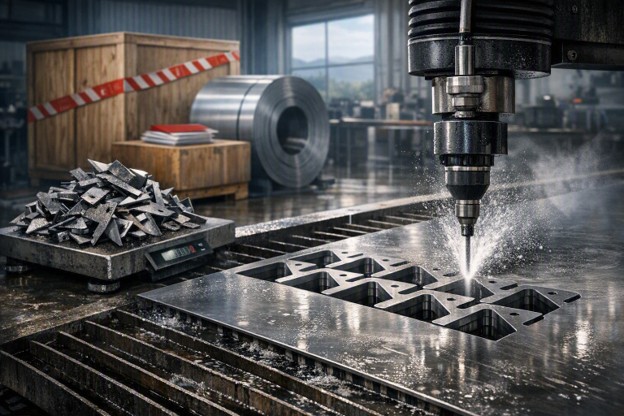
Abrasive waterjet is a cold process. No heat-affected zone means no thermal distortion, which means fewer parts straightened, fewer edges re-machined, and fewer pieces scrapped for warpage on material that is now more expensive to waste. Tight nesting on a single machine that cuts steel, aluminum, foam, and plastic without a tool change keeps more of each sheet in the finished part.
FP Waterjet cuts that work from Landrum for manufacturers across Greenville, Spartanburg, and Anderson.
Note: This article summarizes publicly available federal documents and is not legal, customs, or tax advice. Tariff classification and country-of-melt determinations are fact-specific. Consult a licensed customs broker or trade attorney before making sourcing decisions.
FP Waterjet Services
FP Waterjet provides precision abrasive waterjet cutting to manufacturers across Upstate South Carolina from our Landrum facility. Every job begins with a drawing review and material confirmation.
- Waterjet Cutting Services — Cold cutting across metal, foam, and plastic with no heat-affected zone
- Automotive Waterjet Cutting — Gaskets, seals, brackets, and prototype parts for automotive suppliers
Working with material you cannot afford to waste? Contact FP Waterjet to talk through material, tolerance, and nesting.
Works Cited
“Strengthening Actions Taken To Adjust Imports of Aluminum, Steel, and Copper Into the United States.” Proclamation 11021 of 2 Apr. 2026. Federal Register, vol. 91, 9 Apr. 2026, p. 18201, www.federalregister.gov/documents/2026/04/09/2026-06960/. Accessed 11 Aug. 2026.
“Producer Price Indexes — June 2026.” U.S. Bureau of Labor Statistics, U.S. Department of Labor, 15 July 2026, www.bls.gov/news.release/ppi.nr0.htm. Accessed 11 Aug. 2026.
Related Articles
- Upstate South Carolina’s Manufacturing Surge Is Adding Capital Faster Than It’s Adding People
- BMW’s First U.S.-Built EV Enters Production This Year — What It Means for Upstate Suppliers
About the Author
Chris Urban is the Founder of Forged Path Automation. His 26+ year manufacturing career spans from an international manufacturing specialist trained in Zurich, Switzerland, to corporate President and business owner. Before launching Forged Path Automation (FPA), Chris scaled an industrial gas turbine business unit from its infancy to $50M in value, directed the zero-downtime relocation of 100+ industrial machines to a 150,000 sq. ft. Center of Excellence, and led US operations for a $2.3B global firm. Today, Chris leverages his deep technical roots and an MBA to engineer turnkey robotic finishing cells that deliver total production stability and clear ROI for high-mix manufacturers. Chris holds an advanced background in both the technical and financial sides of manufacturing, combining studies in Applied Science with a Master of Business Administration.
Connect with Chris on LinkedIn to talk shop or discuss your floor’s ROI.
Follow FP Waterjet on LinkedIn or visit FPWaterjet.com.