
FP Waterjet — Precision Waterjet Cutting from Landrum, SC
Before the end of 2026, the first fully electric BMW assembled on American soil will come off the line in Spartanburg. BMW confirmed the iX5 timeline at its June 30 “Home of X” event, alongside the world premiere of the fifth-generation X5 — the first BMW offered with five drivetrain technologies, and the first vehicle in the company’s global network to be assembled across all five on a single line.
For the OEM, that flexibility is the headline achievement. For the supply base across Greenville, Spartanburg, and Anderson, it is a quoting problem that did not exist five years ago.
The Variant Math
A single vehicle built in combustion, diesel, plug-in hybrid, battery electric, and eventually hydrogen fuel cell configurations does not need one bracket. It needs a family of them.
Battery packs and fuel cell stacks occupy space that engines and fuel tanks used to. Thermal management differs across all five. Wire routing, shielding, mounting geometry, sealing surfaces, and acoustic insulation each diverge by drivetrain. A part that once shipped in six-figure annual volumes now splits across variants, and the tooling amortization that justified hard tooling stops working when volume per part number drops by a factor of four or five.
The supplier response is not simply “make less.” It is a structural shift toward jobs that used to be unprofitable: 40-piece runs, first-article turnarounds measured in days, and parts that must be produced without the fixed cost of dedicated tooling.
Multi-Material Is Becoming the Default
The materials story is moving in the same direction. On August 6, Clemson University unveiled Deep Orange 17, a solar-integrated electric prototype developed with BMW’s research and development team, with continuing research based at CU-ICAR in Greenville.
The build is instructive. Its multi-material chassis combines structural steel for passenger safety with aluminum components, carbon fiber structural members, and 3D-printed metal joints — four material families in one structure, chosen to hit a curb weight of 1,212 pounds, roughly a quarter of what comparably sized production vehicles weigh.
Research prototypes run ahead of production, but the direction is not speculative. Efficiency targets push engineers toward mixed-material assemblies, and mixed-material assemblies punish any process that requires a different setup for every material.
The Region Has Production Depth, Not Prototype Depth
South Carolina is unusually production-dense. According to the S.C. Department of Employment and Workforce, federal occupational data put the state’s production workforce at 179,000 jobs with a location quotient of 1.41 — 41 percent more production jobs per capita than the national average, and the highest concentration of any major occupation group in the state.
That is a workforce optimized for running parts, not for developing them. It is exactly the strength that mixed-drivetrain launches stress, because the bottleneck moves upstream to the first article, the design iteration, and the low-volume variant. That capacity mismatch is the subject of Upstate South Carolina’s Manufacturing Surge Is Adding Capital Faster Than It’s Adding People.
What Changes at the Quote Stage
Three things are worth watching in how regional shops price this work.
Setup cost now dominates. When a run is 40 pieces instead of 40,000, fixturing and programming time is the quote, not the per-piece rate.
Secondary operations get scrutinized. A cut edge that needs deburring, or a part that warps and needs straightening, adds handling that short runs cannot absorb.
Material yield matters more than it did. Nesting efficiency and scrap rate are now line items, a pressure examined in 50% Metal Tariffs Are Rewriting the Math on Scrap for Carolina Manufacturers.
Where Waterjet Fits
Abrasive waterjet is not the right answer for every part. For high-volume single-material production, stamping and laser remain faster and cheaper per piece.
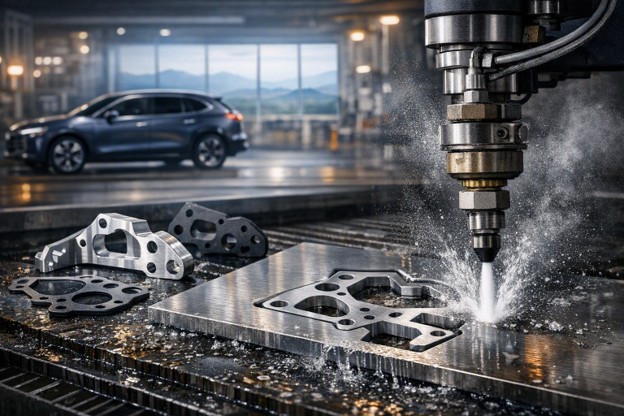
What waterjet handles well is precisely the work variant proliferation creates. It cuts steel, aluminum, foam gaskets, and engineered plastics on the same machine without a tool change. It is a cold process, so there is no heat-affected zone and no thermal distortion to correct downstream. And because there is no dedicated tooling, the cost gap between a one-off prototype gasket and a 200-piece production bracket is close to nothing.
FP Waterjet cuts that work from Landrum, roughly 25 miles from Plant Spartanburg. Automotive customers across Greenville, Spartanburg, and Anderson often pick up the same day rather than wait on freight.
FP Waterjet Services
FP Waterjet provides precision abrasive waterjet cutting for automotive manufacturers and suppliers across Upstate South Carolina. Every job starts with a drawing review and material confirmation, and every part is inspected before it leaves the floor.
- Automotive Waterjet Cutting — Gaskets, seals, brackets, and prototype parts across metal, foam, and plastic
- Waterjet Cutting Services — Cold cutting with no heat-affected zone, from first article through production batch
Have a drawing that needs quoting? Contact FP Waterjet to talk through material, tolerance, and turnaround.
Works Cited
Plumblee, Jordan. “Clemson University Unveils Deep Orange 17, a Solar-Integrated, Energy-Positive Electric Vehicle.” Clemson News, Clemson University, 6 Aug. 2026, news.clemson.edu/clemson-university-unveils-deep-orange-17-a-solar-integrated-energy-positive-electric-vehicle/. Accessed 11 Aug. 2026.
Grady, Bryan. “2025 Occupational Employment and Wage Statistics Released.” South Carolina Department of Employment and Workforce, 5 June 2026, dew.sc.gov/labor-market-information-blog/2026-06/2025-occupational-employment-and-wage-statistics-released. Accessed 11 Aug. 2026.
“BMW Group Completes $1.7 Billion U.S. Investment and Premieres New BMW X5 at ‘Home of X’ Event in Spartanburg, SC.” BMW Group PressClub, BMW Group, 30 June 2026, www.press.bmwgroup.com/global/article/detail/T0458864EN/. Accessed 11 Aug. 2026.
Related Articles
- Upstate South Carolina’s Manufacturing Surge Is Adding Capital Faster Than It’s Adding People
- 50% Metal Tariffs Are Rewriting the Math on Scrap for Carolina Manufacturers
About the Author
Chris Urban is the Founder of Forged Path Automation. His 26+ year manufacturing career spans from an international manufacturing specialist trained in Zurich, Switzerland, to corporate President and business owner. Before launching Forged Path Automation (FPA), Chris scaled an industrial gas turbine business unit from its infancy to $50M in value, directed the zero-downtime relocation of 100+ industrial machines to a 150,000 sq. ft. Center of Excellence, and led US operations for a $2.3B global firm. Today, Chris leverages his deep technical roots and an MBA to engineer turnkey robotic finishing cells that deliver total production stability and clear ROI for high-mix manufacturers. Chris holds an advanced background in both the technical and financial sides of manufacturing, combining studies in Applied Science with a Master of Business Administration.
Connect with Chris on LinkedIn to talk shop or discuss your floor’s ROI.
Follow FP Waterjet on LinkedIn or visit FPWaterjet.com.